Posts Tagged ‘ Zyprexa ’
What’s Making You Fat? 2 Popular Drugs could be Packing on Pounds (or Worse)
July 29th, 2012. By AbiK
 You’re wondering what’s going on, right? It’s not like you’re doing a solo flight with a pint of Häagen-Daz every night before bed or blowing through the Taco Bell drive-thru each day rattling off an order for a couple dozen 99¢ Beefy Nacho Burritos (in a large shopping bag, thanks). But something’s making you gain weight or keep it on…
Indeed, obesity has become what some would call an epidemic. Heck, all you need to do is turn to the media to find words like “diabesity” being used to realize how much obesity—or discussion about it—has infiltrated our lives. But could there must be something else going on?—something other than a big food orgy that most of us didn’t even know we were attending?
Perhaps. That something could be a vicious cycle you’re in—where, by treating a condition that’s potentially related to weight gain, the treatment you’re on can actually lead to more pounds. Unfortunately for some, the treatment can also lead to harmful drug side effects—which in turn can lead to a drug-related personal injury lawsuit. A vicious cycle, indeed. The following two conditions and treatments are examples of vicious cycles that could be causing weight gain and putting you at risk for some unwanted side effects:
1. Antidepressants are Making You Gain Weight
Somehow it’s easy to link depression to weight gain—it’s that “emotional eating” theory. But treating depression with antidepressants can also lead to weight gain. That’s right—the very drug you might be taking to help you avoid emotional eating might also be causing your weight gain. Paxil, Prozac and Zoloft each have possible weight gain as a side effect (in addition to other serious potential side effects like SSRI birth defects or suicidal thoughts). And it’s estimated that about 25% of those taking an antidepressant will experience some weight gain.
Additionally, atypical antipsychotic medications Zyprexa, Abilify, Risperdal and Seroquel have been linked to rapid (and dangerous) weight gain in children.
2. Diabetes Medication is Making You Gain Weight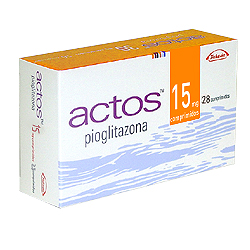
Remember that 70’s Billy Preston song, “Will It Go Round In Circles”? Well, diabetes and treating diabetes have that ‘going around in circles’ thing going on. Unfortunately, being overweight or obese can be a precursor to type 2 diabetes. Once diagnosed, some diabetes patients are put on a thiazolidinedione drug such as Actos. One of the more common side effects of Actos can be weight gain—the very thing that may have contributed to onset of type 2 diabetes in the first place (see it coming full circle?) The Actos labelling info also includes “rapid weight gain” as a possible serious side effect which requires immediate medical attention.
Weight gain may be the least of the worries for Actos side effects, though. Actos has also been associated with bladder cancer, heart failure and liver problems.
As always, before stopping any medication, or when noticing any concerning side effects, talk to your doctor.
Big Pharma Lawsuits – Who Got Hit with the Biggest Settlement?
October 25th, 2010. By LucyC
 It seems that every month practically, one pharmaceutical company or another makes the news for bending rules around marketing. Mis-marketing, which could also be called consumer fraud, can result in serious, if not life-changing consequences for people making decisions about their health.
Recently, I came across a list of the largest settlements paid by 11 pharmaceutical companies for bending the rules. The fines total a staggering $6 billion. The more frequent offender, according to the company that compiled the list, is Eli Lilly. They paid more than $1.4 billion in fines all for various violations for just one drug—Zyprexa.
And then there’s Pfizer, who paid $2.3 billion for ‘mis-marketing’ a number of drugs including Bextra, Geodon, Lyrica and Zyvox.
These drugs are used to treat everything from schizophrenia to epilepsy to diabetes, and the consequences of not having the correct information may have resulted in serious adverse health events, possibly even death for some.
Not surprisingly, people tend to be very interested when the big boys get caught behaving badly, for a variety of reasons, not the least of which being that we feel our trust has been betrayed. We trust drug companies, and the medical profession in general, to give us the straight goods because it’s a matter of life and death. Why would you not be straight about that? Well, the answer is, not surprisingly, money. And lots of it. But eventually the offenders do get caught. And that leads to drug lawsuits, criminal investigations and ultimately, very large fines.
So, without further ado—here’s a list of the big offenders—who took them on, what for and how much they paid, with acknowledgement to FiercePharma.com who actually did the homework on this.
Novartis
With: U.S. Attorney’s office for the Eastern District of Pennsylvania
When: Sept. 30, 2010
Why: Novartis agreed to a $422.5 million settlement with the Eastern District of Pennsylvania for its off-label promotion of Trileptal and other allegations against Diovan, Exforge, Sandostatin, Tekturna and Zelnorm. (oh, and ps, Novartis is recruiting for a Senior Brand Manager for Prevacid…)
Forest Labs
With: Dept. of Justice
When: Sept. 15, 2010
Why: After marketing Levothroid, an unapproved thyroid drug, Forest Labs received a $313 million penalty. The settlement also covered Forest’s off-label use of Celexa for children’s use.
Allergan
With: Dept. of Justice
When: Sept. 1, 2010
Why: Allergan’s was fined $600 million by the Department of Justice. The settlement was broken into two parts: $375 million in fines and $225 milion in civil penalties, all of which stemmed from its off-label use of Botox for headaches, pain management and cerebral palsy.
Elan
With: U.S. Attorney’s Office in Massachusetts
When: July 15, 2010
Why: Elan received a $203.5 million fine for its marketing of Zonegran, an epilepsy drug.
Johnson & Johnson
With: Department of Justice
When: April 29, 2010
Why: Though J&J is most recently famous or a rash of phantom recalls, two of the troubled drugmaker’s subsidiaries received a $81 million penalty for off-label promotions of Topamax, an epilepsy drug.
AstraZeneca
With: U.S. Attorney’s office in Philadelphia
When: April 27, 2010
Why: In the same week as the J&J settlement, AstraZeneca was fined $520 million misleading doctors and patients about the safety of its antipsychotic drug Seroquel.
Abbott
With: Twenty-three states
When: Jan. 7, 2010
Why: In a case involving 23 different states, Abbott Laboratories and its partner, Fournier Industrie et Sante, were ordered to pay $22.5 million for blocking the states from obtaining a cheaper alternative for its cholesterol drug, TriCor. (btw, Abbott Labs is the one who brought you beetle parts in Similac, causing the recent Similac recall…)
Eli Lilly
With: Connecticut
When: Sept. 29, 2009
Why: A total of 13 states total had filed suit against Eli Lilly for Zyprexa marketing issues, but the company was ordered to pay $25 million to Connecticut in this ruling.
Eli Lilly
With: West Virginia Attorney General
When: August 21, 2009
Why: In another Zyprexa case, West Virginia Attorney General Darrell McGraw levied $2 billion in fines against Eli Lilly. In the end, the company agreed to $22.5 million in fines.
Merck
With: 35 states’ attorney offices
When: July 15, 2009
Why: Following a 35 state investigations into the Enhance study of Vytorin, Merck paid $5.4 million in fines, without admitting fault in the cases.
Sanofi-Aventis
With: Department of Justice
When: May 28, 2009
Why: In an agreement with the federal government, Sanofi paid $95.5 million total, to the federal government, state Medicaid agencies and other public health service agencies, all for its subsidiary Aventis’ nasal spray price inflation between 1995 and 2000.
GlaxoSmithKline
With: U.S. Attorney’s office in Colorado
When: Jan. 29, 2009
Why: After seven years of off-label promotion on nine of its best-selling drugs, GlaxoSmithKline (GSK) was ordered to pay $400 million to the U.S. Attorney’s office in Colorado.
Pfizer
With: Department of Justice
When: Jan. 26, 2009
Why: Right after acquiring Wyeth, Pfizer dropped a bombshell in its fourth quarter earnings report; the company was charged $2.3 billion for off-label promotions of its COX-2 drugs.
Eli Lilly
With: Department of Justice
When: Jan. 15, 2009
Why: In the first Zyprexa settlement (and one of three on our list), the Department of Justice levied $1.4 billion in fines against Eli Lilly. Also, as part of the settlement, the company pled guilty to a misdemeanor: violating the Food, Drug and Cosmetic Act.
FDA vs Attorneys: Who Really Protects Us?
September 27th, 2010. By janem
 There’s always some whining going on about how much money lawyers make from pharmaceutical class actions. But do those whiners ever think about how safe we would be were it not for the lawyers, lawsuits and the courts? Let’s add advocacy and consumer groups too—their actions have also kept us safe from dangerous drugs and their side effects.
Relying on the FDA for post-market surveillance once it has approved a drug reminds me of this old adage: Close the stable door after the horse has bolted. All too often it takes consumers and their attorneys—like a band of Davids against the Goliath drug company—to resolve adverse drug events that occur by underhanded tactics such as off-label promotion and false advertising. Case in point: the diabetes drug Byetta.
The FDA received reports of adverse health events (kidney problems and pancreatitis) from Byetta users since the beginning of 2005 but they did diddly squat until last November, when in their infinite wisdom, finally said, “Byetta can heighten the risk of kidney problems, including kidney failure, in people suffering from type 2 diabetes.” But not before attorneys were filing class action lawsuits against the manufacturer.
And what about Avandia? In 2007, a report in the New England Journal of Medicine, linked Avandia to a 43 percent increased risk of heart attack, and more than 700 lawsuits—with GlaxoSmithKline agreeing to a $60 million settlement. Yet it took the FDA until September 2010 to severely restrict sales of the drug (sales have been completely suspended in Europe).
And let’s consider Zyprexa. Class action lawsuits alleged that the manufacturer, Eli Lilly and Co., negligently made, marketed and sold Zyprexa without properly warning of the risks prior to June 6, 2007. Eli Lilly paid out approximately $1.5 billion to settle civil and criminal claims alleging illegal marketing—promoting the drug for use in seniors with dementia when it is not approved for that use.
As well, Eli Lilly paid millions of dollars to settle claims alleging the increased risk of diabetes and related health problems, but the settlement does not imply liability or wrongdoing, so are we safer as a result? The drug is still sold, but with the labeling clearly showing diabetes-related side effects. But Zyprexa treats psychosis—how many people with schizophrenia or bi-polar disorder are going to read the label? Attorneys have taken the drug company to court; now isn’t it up to the FDA to take the drug off the market? Or at the very least, the agency should be more diligent with post market surveillance.
Kevin Bacon Game helps Decipher Diabetes-related Drug Lawsuits
September 2nd, 2010. By AbiK
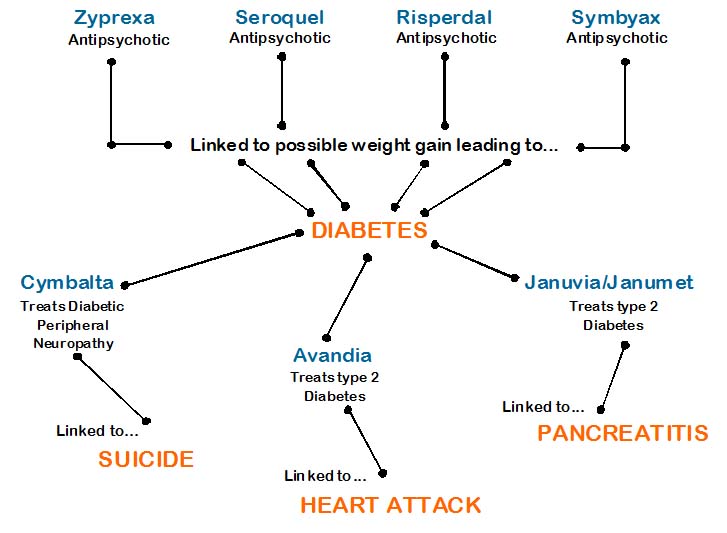
If you’ve ever wondered why certain drugs (Zyprexa, Avandia, Seroquel, Cymbalta…to name a few) seem to have something in common, but you just can never really put your finger on it, well, it’s time to look to the Kevin Bacon Game (aka, Six Degrees of Separation, with some liberties taken) to find out what those connections are…so here goes…
Antidepressant Guide: the Brands, the Generics & Who Makes Them
May 6th, 2010. By Kristine B
 These days, there are many drugs to keep track of. It’s not just the brand name drug anymore; patients could be taking a generic equivalent. So, this week, Pleading Ignorance looks at the SSRIs and SNRIs to give you the brand name, manufacturer, generic version and the generic’s manufacturer. Consider it your one-stop cheat sheet on some of the more commonly prescribed antidepressants.
|
Brand name |
Ingredient |
Made By |
Generic |
Made By |
|
|
|
|
|
|
|
Celexa (SSRI) |
citalopram hydrobromide |
Forest Laboratories |
citalopram |
Eon Labs, Inc., Aurobindo Pharma Limited, Purepac Pharmaceutical Co., Dr. Reddy’s Laboratories Limited, Corepharma LLC |
|
Lexapro (SSRI) |
escitalopram oxalate |
Forest Laboratories |
escitalopram |
Alphrapharm |
|
Paxil/Seroxat (SSRI) |
paroxetine hydrochloride |
GlaxoSmithKline |
paroxetine |
Apotex, Alphapharm, Teva, Aurobindo Pharma, Zydus Pharms USA, Caraco |
|
Prozac (SSRI) |
fluoxetine hydrochloride |
Eli Lilly and Company |
fluoxetine |
ESI Lederle (tentative approval) |
|
Symbyax (SSRI) |
olanzapine and fluoxetine hydrochloride |
Eli Lilly and Company |
olanzapine/ fluoxetine |
Teva Pharms (tentative approval, July 17, 2007) |
|
Zoloft (SSRI) |
sertraline hydrochloride |
Pfizer Pharmaceuticals |
sertraline |
Dr Reddy’s Labs Ltd, Teva, Genpharm, Aurobindo Pharma, Sandoz and many others |
|
Zyprexa (atypical antipsychotic) |
olanzapine |
Eli Lilly and Company |
olanzapine |
All tentative approval: Dr. Reddy’s Labs Inc, Teva Pharms, Mylan PHarma, Sandoz, Barr Pharms, Roxane |
|
Cymbalta (SNRI) |
duloxetine hydrochloride |
Eli Lilly and Company |
duloxetine |
No generic so far as I can tell |
|
Effexor (SNRI) |
venlafaxine |
Wyeth |
venlafaxine hydrochloride |
Aurobindo, Mylan, Teva, Dr Reddy’s Labs Ltd, Caraco and others |
The information in the chart above was found at either drugs@fda, or on the individual drug manufacturer’s website. As far as I can tell, this information is correct as of the date it was written—and it is not intended to replace the information you might receive from your doctor or medical practitioner (hey, have to say it, we’re a legal site). Talk to your doctor or pharmicist for medical advice.

Find us on


Archive by Category
- Accidents (24)
- Airlines (9)
- Asbestos Mesothelioma (262)
- Automotive (25)
- Celebrity (14)
- Class Action (84)
- Complaints/Comments (15)
- Consumer Fraud (84)
- Contest (2)
- Court of Public Opinion (5)
- Crazy Sh*t Lawyers See (61)
- Criminal Law (4)
- Defective Products (111)
- DePuy ASR Hip Recall (2)
- Discrimination (22)
- Drugs/Medical (248)
- Elder Care Abuse (4)
- Emerging Issues (462)
- Employment (54)
- Environment (52)
- Financial (28)
- Food Illness (15)
- Human/Civil Rights (4)
- Insecurities (5)
- Insurance (16)
- Intellectual Property (16)
- Internet/E-commerce (19)
- lawsuits (161)
- Lawyers (20)
- Lawyers Giving Back (43)
- Lex Levity (10)
- Personal Injury (106)
- Pleading Ignorance (53)
- Real Estate (2)
- Recall (6)
- Scam (3)
- Securities (13)
- Settlement (81)
- Tort Reform (2)
- Totally Tortelicious (81)
- Veterans (11)
- Whistleblower (9)