Posts Tagged ‘ Pfizer ’
Score One for the FDA as Rest of World Finally Yanks Thelin
January 3rd, 2011. By Hunter West
 Time to give credit where credit is due. And this time, the US Food and Drug Administration (FDA) got it right.
Recently it was announced, in a joint statement by Health Canada and Pfizer Canada, that Thelin (sitaxsentan) was being taken off the market in Canada, as well as every country in which it had been sold, due to risk for potentially fatal liver damage.
Never heard of Thelin? There’s a reason for that. Thelin is not available in the US. Never was. That’s because the FDA refused to approve the drug designed to treat pulmonary hypertension. In the view of the FDA, the benefits did not outweigh the risks.
In a bid to win FDA approval for marketing Thelin in this country, Pfizer Inc. launched a series of clinical trials. However, those trials have been abandoned following the deaths of three trial participants.
According to a report in the Globe and Mail, Canada’s national newspaper, liver damage was a known complication of Thelin. However, in announcing that it was abandoning further clinical trials, Pfizer noted that it had discovered a “new potentially life-threatening idiosyncratic risk” of liver injury among patients that is difficult to predict or guard against.
Thus, there will be no further clinical trials, and Thelin will be coming off the market in Australia, Europe and Canada where it had been previously approved. Given the known risks associated with Thelin, Canadians are wondering how Thelin ever won Health Canada approval in the first place.
The FDA has been maligned, chastised, ridiculed and kicked to the curb over the appearance of lax oversight both in the approval, and ongoing supervision of drugs and medical devices. And to be sure, much of that criticism is warranted.
However, on this occasion the FDA stuck to its guns and has been vindicated. There can be Read the rest of this entry »
Big Pharma Lawsuits – Who Got Hit with the Biggest Settlement?
October 25th, 2010. By LucyC
 It seems that every month practically, one pharmaceutical company or another makes the news for bending rules around marketing. Mis-marketing, which could also be called consumer fraud, can result in serious, if not life-changing consequences for people making decisions about their health.
Recently, I came across a list of the largest settlements paid by 11 pharmaceutical companies for bending the rules. The fines total a staggering $6 billion. The more frequent offender, according to the company that compiled the list, is Eli Lilly. They paid more than $1.4 billion in fines all for various violations for just one drug—Zyprexa.
And then there’s Pfizer, who paid $2.3 billion for ‘mis-marketing’ a number of drugs including Bextra, Geodon, Lyrica and Zyvox.
These drugs are used to treat everything from schizophrenia to epilepsy to diabetes, and the consequences of not having the correct information may have resulted in serious adverse health events, possibly even death for some.
Not surprisingly, people tend to be very interested when the big boys get caught behaving badly, for a variety of reasons, not the least of which being that we feel our trust has been betrayed. We trust drug companies, and the medical profession in general, to give us the straight goods because it’s a matter of life and death. Why would you not be straight about that? Well, the answer is, not surprisingly, money. And lots of it. But eventually the offenders do get caught. And that leads to drug lawsuits, criminal investigations and ultimately, very large fines.
So, without further ado—here’s a list of the big offenders—who took them on, what for and how much they paid, with acknowledgement to FiercePharma.com who actually did the homework on this.
Novartis
With: U.S. Attorney’s office for the Eastern District of Pennsylvania
When: Sept. 30, 2010
Why: Novartis agreed to a $422.5 million settlement with the Eastern District of Pennsylvania for its off-label promotion of Trileptal and other allegations against Diovan, Exforge, Sandostatin, Tekturna and Zelnorm. (oh, and ps, Novartis is recruiting for a Senior Brand Manager for Prevacid…)
Forest Labs
With: Dept. of Justice
When: Sept. 15, 2010
Why: After marketing Levothroid, an unapproved thyroid drug, Forest Labs received a $313 million penalty. The settlement also covered Forest’s off-label use of Celexa for children’s use.
Allergan
With: Dept. of Justice
When: Sept. 1, 2010
Why: Allergan’s was fined $600 million by the Department of Justice. The settlement was broken into two parts: $375 million in fines and $225 milion in civil penalties, all of which stemmed from its off-label use of Botox for headaches, pain management and cerebral palsy.
Elan
With: U.S. Attorney’s Office in Massachusetts
When: July 15, 2010
Why: Elan received a $203.5 million fine for its marketing of Zonegran, an epilepsy drug.
Johnson & Johnson
With: Department of Justice
When: April 29, 2010
Why: Though J&J is most recently famous or a rash of phantom recalls, two of the troubled drugmaker’s subsidiaries received a $81 million penalty for off-label promotions of Topamax, an epilepsy drug.
AstraZeneca
With: U.S. Attorney’s office in Philadelphia
When: April 27, 2010
Why: In the same week as the J&J settlement, AstraZeneca was fined $520 million misleading doctors and patients about the safety of its antipsychotic drug Seroquel.
Abbott
With: Twenty-three states
When: Jan. 7, 2010
Why: In a case involving 23 different states, Abbott Laboratories and its partner, Fournier Industrie et Sante, were ordered to pay $22.5 million for blocking the states from obtaining a cheaper alternative for its cholesterol drug, TriCor. (btw, Abbott Labs is the one who brought you beetle parts in Similac, causing the recent Similac recall…)
Eli Lilly
With: Connecticut
When: Sept. 29, 2009
Why: A total of 13 states total had filed suit against Eli Lilly for Zyprexa marketing issues, but the company was ordered to pay $25 million to Connecticut in this ruling.
Eli Lilly
With: West Virginia Attorney General
When: August 21, 2009
Why: In another Zyprexa case, West Virginia Attorney General Darrell McGraw levied $2 billion in fines against Eli Lilly. In the end, the company agreed to $22.5 million in fines.
Merck
With: 35 states’ attorney offices
When: July 15, 2009
Why: Following a 35 state investigations into the Enhance study of Vytorin, Merck paid $5.4 million in fines, without admitting fault in the cases.
Sanofi-Aventis
With: Department of Justice
When: May 28, 2009
Why: In an agreement with the federal government, Sanofi paid $95.5 million total, to the federal government, state Medicaid agencies and other public health service agencies, all for its subsidiary Aventis’ nasal spray price inflation between 1995 and 2000.
GlaxoSmithKline
With: U.S. Attorney’s office in Colorado
When: Jan. 29, 2009
Why: After seven years of off-label promotion on nine of its best-selling drugs, GlaxoSmithKline (GSK) was ordered to pay $400 million to the U.S. Attorney’s office in Colorado.
Pfizer
With: Department of Justice
When: Jan. 26, 2009
Why: Right after acquiring Wyeth, Pfizer dropped a bombshell in its fourth quarter earnings report; the company was charged $2.3 billion for off-label promotions of its COX-2 drugs.
Eli Lilly
With: Department of Justice
When: Jan. 15, 2009
Why: In the first Zyprexa settlement (and one of three on our list), the Department of Justice levied $1.4 billion in fines against Eli Lilly. Also, as part of the settlement, the company pled guilty to a misdemeanor: violating the Food, Drug and Cosmetic Act.
Pfizer’s Secret Friend
April 9th, 2010. By Hunter West
 Mom and Dad told us not to be ‘too big for your britches.’ However in the Land of Big Pharma, that basic chestnut of moral integrity need not apply…
Remember the debacle over Bextra? Pfizer was found to have actively marketed the drug for off-label use, for things not approved by the US Food and Drug Administration (FDA), and was called to the carpet over it, paying about $2 billion in penalties.
However, it could have been a lot worse, according to a special investigation by CNN that found Pfizer escaped the expected death knell in such cases by being permanently excluded from Medicare and Medicaid.
Most know the story of Bextra, the Cox-2 inhibitor that Pfizer brought to the painkiller market in 2001 with big plans. Cox-2 inhibitors were thought to be safer than generic drugs.
Also more expensive, coming in at 20 times the cost of ibuprofen.
Nonetheless, the plan was to market Bextra for acute pain, such as that experienced by patients following surgery.
Enter the FDA, which put a noose around Pfizer’s neck when it decreed that Bextra was not safe for patients at high risk for heart attack and stroke. Thus the approval was limited to pain treatment related to arthritis and menstrual cramps.
Undaunted, the marketing and sales arms of Pfizer—allegedly without knowledge of top executives—set to work circumventing that regulatory authority by promoting its use off-label to anesthesiologists, orthopedic surgeons, “anyone that use[d] a scalpel for a living,” according to the words of one district manager.
There were other lapses in marketing judgment that flew in the face of regulatory decorum. In the end, by the time Bextra was Read the rest of this entry »
16 Days to File for Bextra, Celebrex Settlement
October 7th, 2009. By AbiK
I can’t get that Tai-Chi woman out of my head from the initial Celebrex ads way back when–remember those ads? Regardless, if you were buying Celebrex (or Bextra) back then, just a reminder…the deadline to file a claim (or opposition) for the Pfizer Bextra and Celebrex Settlement is October 23, 2009…16 days from now.
What’s the Bextra & Celebrex Settlement about?
The lawsuit claimed that Pfizer marketed Bextra and Celebrex as having more benefit than non-selective Non-Steroidal Anti-Inflammatory Drugs (NSAIDs) like ibuprofen or naproxen (that you can find on drugstore and grocery store shelves), when such benefits had not been established. Additionally, the lawsuit claimed that Pfizer’s marketing of Bextra and Celebrex was inconsistent with their FDA-approved labels, and that these false marketing tactics made consumers pay more for Bextra and Celebrex than they might have been able to pay for OTC NSAIDs, or no medication at all.
The Bextra/Celebrex Settlement is $89 million, and will be paid out in the following manner: 70% to Third-Party Payors, and 30% to consumers.
Does the Bextra & Celebrex Settlement affect you?
If you paid for a Bextra or Celebrex prescription on or before July 29, 2005, you may be part of the class and eligible to file a claim. Read the rest of this entry »
Another Whistleblower Movie: A True Story, But Is It Real?
September 22nd, 2009. By Hunter West
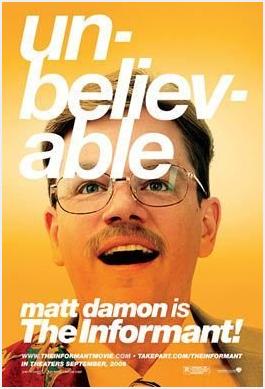 The whistleblower has come to the big screen yet again, although the movie starring Matt Damon that debuted Friday—The Informant—was hardly the same story as whistleblower John Kopchinski, whose six-year battle with Pfizer recently ended with a “qui tam” lawsuit settlement of $51.5 million for him.
For all his trouble in blowing the whistle on Archer Daniels Midland (ADM), Mark Whitacre got 9 years in prison. But that’s not just because he worked with the FBI for three years, wearing wires and employing other surveillance devices in an attempt to expose alleged price-fixing of lysine, a food additive. Where Whitacre went wrong was losing his trust in the FBI, and going off the bipolar deep end by abandoning his quest to bring down the company, instead drifting down the embezzlement sinkhole, defrauding $9 million from his own employer.
In the end, the whistleblower did more time for his own misdeeds, than the price-fixing executives he initially sought to expose.
In contrast, John Kopchinski had a slightly easier time, and a much bigger reward at the end of his struggle. The former soldier was earning $125,000 a year at Pfizer when he was fired in 2003 after he complained to his superiors about the underhanded marketing tactics the pharmaceutical giant was using to vend its drug Bextra. Read the rest of this entry »

Find us on


Archive by Category
- Accidents (24)
- Airlines (9)
- Asbestos Mesothelioma (262)
- Automotive (25)
- Celebrity (14)
- Class Action (84)
- Complaints/Comments (15)
- Consumer Fraud (84)
- Contest (2)
- Court of Public Opinion (5)
- Crazy Sh*t Lawyers See (61)
- Criminal Law (4)
- Defective Products (111)
- DePuy ASR Hip Recall (2)
- Discrimination (22)
- Drugs/Medical (248)
- Elder Care Abuse (4)
- Emerging Issues (462)
- Employment (54)
- Environment (52)
- Financial (28)
- Food Illness (15)
- Human/Civil Rights (4)
- Insecurities (5)
- Insurance (16)
- Intellectual Property (16)
- Internet/E-commerce (19)
- lawsuits (161)
- Lawyers (20)
- Lawyers Giving Back (43)
- Lex Levity (10)
- Personal Injury (106)
- Pleading Ignorance (53)
- Real Estate (2)
- Recall (6)
- Scam (3)
- Securities (13)
- Settlement (81)
- Tort Reform (2)
- Totally Tortelicious (81)
- Veterans (11)
- Whistleblower (9)