Posts Tagged ‘ Merck ’
Propecia Isn’t Supposed to Make Things Disappear, is it?
February 15th, 2012. By AbiK
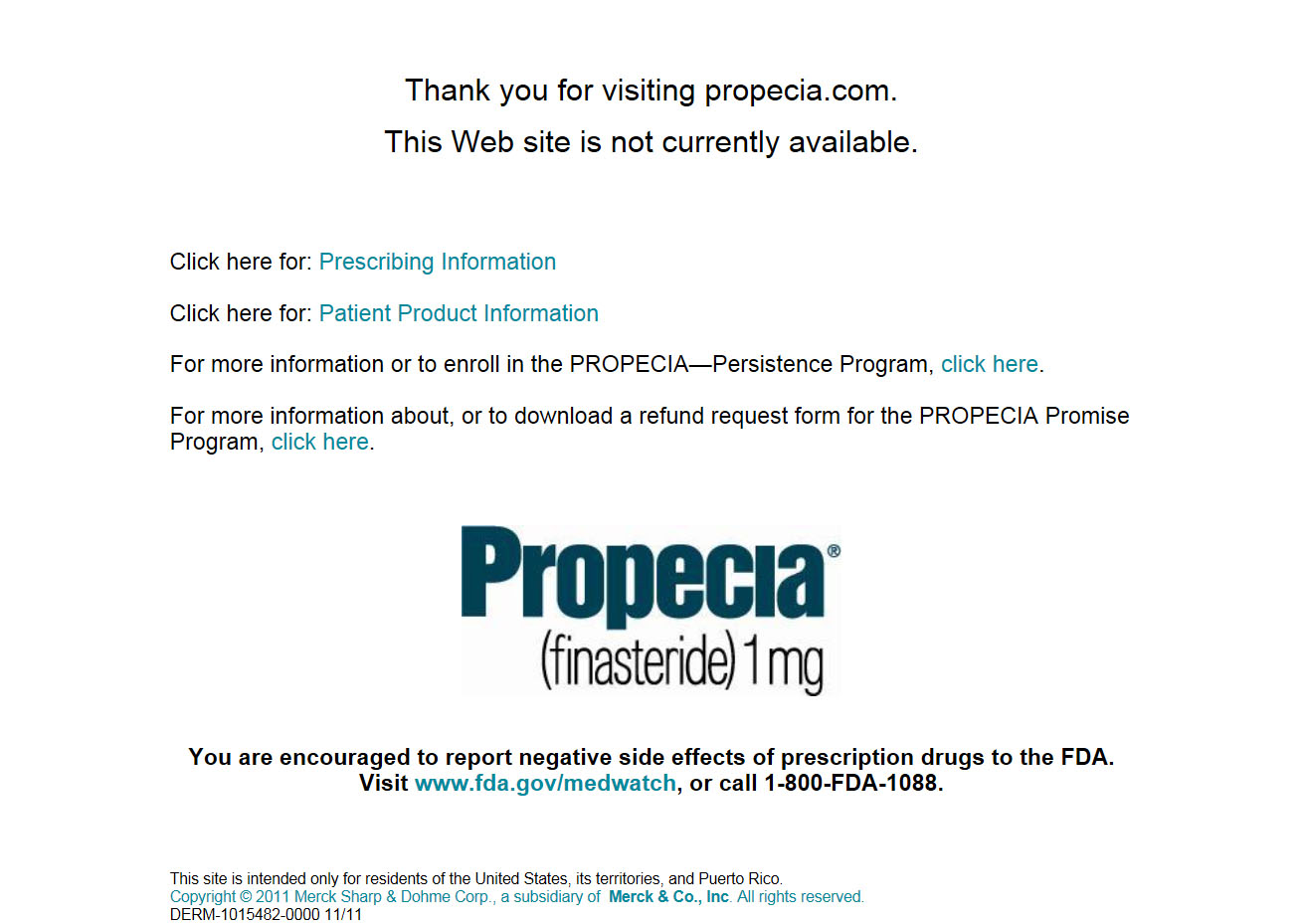
Funny thing happened on the way to the Propecia website—it wasn’t there! LawyersandSettlements.com recently posted an article about the disappearing act that Merck did with its Propecia site (see image) but one can’t help but appreciate the irony of something that’s supposed to be marketed to make hair appear now, well, disappearing. Stay tuned. And meanwhile, if you or someone you know has used Propecia and lost more than you gained (i.e., lost sexual desire or the ability to perform sexually), read more about Propecia lawsuits here.
Thousands may have Claim for Pharmaceutical Sales Rep Overtime
March 2nd, 2011. By LucyC
 Well, it looks like the little guys could have it. Yesterday, February 28, 2011, the US Supreme Court announced that it would not reconsider appellate court decisions against Novartis and Merck Schering regarding unpaid overtime class actions.
Essentially, this means that Novartis may have to pony up $100 million or more in back overtime as settlement for some 2,500 plaintiffs.
In so doing, the Supreme Court leaves intact two separate decisions against Novartis and Schering Corp. In July 2010, the 2nd Circuit issued a pair of rulings that found the pharmaceutical sales reps were covered by federal wage-and-hour law.
But—it ain’t over as the expression goes—until the fat lady sings. At least half a dozen pharmaceutical companies are tied up in overtime suits, according to various media sources, and yesterday’s US Supreme Court decision presents a major conundrum. According to the attorneys that represented the Novartis employees, the various rulings against the pharmaceutical companies have ‘opened the floodgates for liability.’ This same law firm is currently representing plaintiffs in four identical wage-and-hour lawsuits against Pfizer, Roche, Merck and Abbott Laboratories. So the bigger question is—does this decision translate into overtime requirements for all pharmaceutical sales reps? (Now we’re talking tens of thousands of workers.)
That remains to be seen, in part because the courts themselves are guilty of issuing conflicting information—other appellate court decisions have decided in favor of the employers. The reason? It’s all down to interpretation. A report in the Star-Ledger indicates that this Supreme Court ruling was partly based on a brief from the Department of Labor that supports the sales’ reps stance on qualifying for overtime pay. As far as Novartis is concerned, they intend to evaluate ‘all legal options.’ Part of an email published in the Star-Ledger, from Novartis, states, “For decades, companies in the pharmaceutical industry have classified their sales representatives as exempt employees and have compensated them on a pay-for-performance basis, the same way they compensate executives, managers and other professionals.”
And, in a brief submitted by Merck, the pharmaceutical company reportedly wrote that another appellate court concluded that “no deference was owed to DOL’s new interpretation expressed in its brief.”(Star-Ledger). Of course Merck isn’t too happy about the Supreme Court ruling either. The company inherited an overtime lawsuit against Schering-Plough, when it acquired SP in 2009.
It doesn’t help that the Supreme Court offered no comment whatsoever on its decision: an explanation making clear their reasons for their decision could have helped in reducing the likelihood of further legal wrangling—which will almost certainly occur because the stakes here are high indeed.
The Pharmaceutical Research and Manufacturers Association (PhRMA), which is the leading trade group representing the US pharmaceutical industry, had argued in its petition to the Supreme Court that the lower court’s decision had “potentially far-reaching ramifications’’ for the industry, and called the decision against Novartis an error. “The decision unexpectedly exposes PhRMA members to potentially staggering retroactive liability from lawsuits by current and former employees,’’ the brief stated. “Serious consequences loom because of nothing more than an unexplained change in the Department of Labor’s interpretation of its regulations.’’ (Star-Ledger)
Of course, none of this changes the fact that the reps who filed the suit against Novartis—more than four years ago now—did put in the time—as much as 70 hours per week, according to their lawyers.
Frankly, I can’t help thinking that the whole debate around unpaid overtime is just a little too Dickensian for 2011, and that a little more clarity would go a long way to improving the situation for both sides.
Big Pharma Lawsuits – Who Got Hit with the Biggest Settlement?
October 25th, 2010. By LucyC
 It seems that every month practically, one pharmaceutical company or another makes the news for bending rules around marketing. Mis-marketing, which could also be called consumer fraud, can result in serious, if not life-changing consequences for people making decisions about their health.
Recently, I came across a list of the largest settlements paid by 11 pharmaceutical companies for bending the rules. The fines total a staggering $6 billion. The more frequent offender, according to the company that compiled the list, is Eli Lilly. They paid more than $1.4 billion in fines all for various violations for just one drug—Zyprexa.
And then there’s Pfizer, who paid $2.3 billion for ‘mis-marketing’ a number of drugs including Bextra, Geodon, Lyrica and Zyvox.
These drugs are used to treat everything from schizophrenia to epilepsy to diabetes, and the consequences of not having the correct information may have resulted in serious adverse health events, possibly even death for some.
Not surprisingly, people tend to be very interested when the big boys get caught behaving badly, for a variety of reasons, not the least of which being that we feel our trust has been betrayed. We trust drug companies, and the medical profession in general, to give us the straight goods because it’s a matter of life and death. Why would you not be straight about that? Well, the answer is, not surprisingly, money. And lots of it. But eventually the offenders do get caught. And that leads to drug lawsuits, criminal investigations and ultimately, very large fines.
So, without further ado—here’s a list of the big offenders—who took them on, what for and how much they paid, with acknowledgement to FiercePharma.com who actually did the homework on this.
Novartis
With: U.S. Attorney’s office for the Eastern District of Pennsylvania
When: Sept. 30, 2010
Why: Novartis agreed to a $422.5 million settlement with the Eastern District of Pennsylvania for its off-label promotion of Trileptal and other allegations against Diovan, Exforge, Sandostatin, Tekturna and Zelnorm. (oh, and ps, Novartis is recruiting for a Senior Brand Manager for Prevacid…)
Forest Labs
With: Dept. of Justice
When: Sept. 15, 2010
Why: After marketing Levothroid, an unapproved thyroid drug, Forest Labs received a $313 million penalty. The settlement also covered Forest’s off-label use of Celexa for children’s use.
Allergan
With: Dept. of Justice
When: Sept. 1, 2010
Why: Allergan’s was fined $600 million by the Department of Justice. The settlement was broken into two parts: $375 million in fines and $225 milion in civil penalties, all of which stemmed from its off-label use of Botox for headaches, pain management and cerebral palsy.
Elan
With: U.S. Attorney’s Office in Massachusetts
When: July 15, 2010
Why: Elan received a $203.5 million fine for its marketing of Zonegran, an epilepsy drug.
Johnson & Johnson
With: Department of Justice
When: April 29, 2010
Why: Though J&J is most recently famous or a rash of phantom recalls, two of the troubled drugmaker’s subsidiaries received a $81 million penalty for off-label promotions of Topamax, an epilepsy drug.
AstraZeneca
With: U.S. Attorney’s office in Philadelphia
When: April 27, 2010
Why: In the same week as the J&J settlement, AstraZeneca was fined $520 million misleading doctors and patients about the safety of its antipsychotic drug Seroquel.
Abbott
With: Twenty-three states
When: Jan. 7, 2010
Why: In a case involving 23 different states, Abbott Laboratories and its partner, Fournier Industrie et Sante, were ordered to pay $22.5 million for blocking the states from obtaining a cheaper alternative for its cholesterol drug, TriCor. (btw, Abbott Labs is the one who brought you beetle parts in Similac, causing the recent Similac recall…)
Eli Lilly
With: Connecticut
When: Sept. 29, 2009
Why: A total of 13 states total had filed suit against Eli Lilly for Zyprexa marketing issues, but the company was ordered to pay $25 million to Connecticut in this ruling.
Eli Lilly
With: West Virginia Attorney General
When: August 21, 2009
Why: In another Zyprexa case, West Virginia Attorney General Darrell McGraw levied $2 billion in fines against Eli Lilly. In the end, the company agreed to $22.5 million in fines.
Merck
With: 35 states’ attorney offices
When: July 15, 2009
Why: Following a 35 state investigations into the Enhance study of Vytorin, Merck paid $5.4 million in fines, without admitting fault in the cases.
Sanofi-Aventis
With: Department of Justice
When: May 28, 2009
Why: In an agreement with the federal government, Sanofi paid $95.5 million total, to the federal government, state Medicaid agencies and other public health service agencies, all for its subsidiary Aventis’ nasal spray price inflation between 1995 and 2000.
GlaxoSmithKline
With: U.S. Attorney’s office in Colorado
When: Jan. 29, 2009
Why: After seven years of off-label promotion on nine of its best-selling drugs, GlaxoSmithKline (GSK) was ordered to pay $400 million to the U.S. Attorney’s office in Colorado.
Pfizer
With: Department of Justice
When: Jan. 26, 2009
Why: Right after acquiring Wyeth, Pfizer dropped a bombshell in its fourth quarter earnings report; the company was charged $2.3 billion for off-label promotions of its COX-2 drugs.
Eli Lilly
With: Department of Justice
When: Jan. 15, 2009
Why: In the first Zyprexa settlement (and one of three on our list), the Department of Justice levied $1.4 billion in fines against Eli Lilly. Also, as part of the settlement, the company pled guilty to a misdemeanor: violating the Food, Drug and Cosmetic Act.
Is Your Doctor Getting Cash from Big Pharma? Find Out
October 20th, 2010. By AbiK
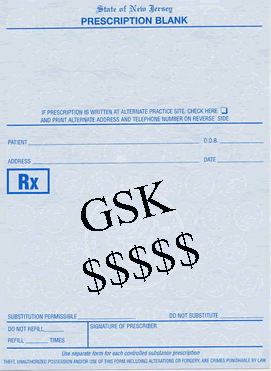 It’s been a good year for Dr. Firhaad Ismail. Indeed! Financially speaking, that is. See, according to the info over at ProPublica, in their Dollars for Docs report, Dr. Ismail took in no less than $303,558 from big pharmaceutical companies GlaxoSmithKline (GSK…the folks who brought you Avandia and Paxil), Eli LIlly, and Merck.
Now, Dr. Ismail is just one of 384 doctors nationwide who’ve received payment from big pharma. Ismail is based in Vegas (clearly, if ProPublica’s involved, what goes on in Vegas is not staying in Vegas) and his specialty is Endocrinology and Metabolism. And he appears to do a fair amount of consulting on the topic. On big pharma’s dime.
Dr. Ismail may be the best damn doctor there is in his specialty. I don’t know. But what I do know is that the ProPublica report indicates that Dr. Ismail received a total of $209,400 from GSK alone. Recall what area of practice Dr. Ismail is in…Endocrinology. What does Endocrinology deal with? Well, diabetes for one. And last I checked, Avandia is a type 2 diabetes drug made by GSK.
I’m just putting on the table what’s already out there. I’m not saying there’s any unsavory relationship here…but I the jaded skeptic in me does raise a little eyebrow…
Needless to say, I’ve been checking out my own doctors over at ProPublica.com. You can, too. Just hop over to Dollars for Docs and do a search for your doctor’s name, by state. You can also find a full list there of all the doctors nationwide.
Let us know what you find…and if you think doctors receiving funds from big pharma presents a conflict of interest.
Worth a Read – Fosamax Article in More Magazine
June 7th, 2010. By AbiK
 Finally got to catch up on some reading this weekend and found myself flipping through the latest More magazine. The one with Sharon Stone on the cover—looking great at 52 (not to take away from Stone’s smarts or her three adopted children, but my response to any “hot body over 40” (or 50) press is, ok, but has she gone through childbirth?—and sans plastic surgery? if so, then let’s talk; otherwise, get real.) But I digress.
What I really want to talk about is the article by Katharine Davis Fishman that’s a bit further back in the June issue. Page 119, to be exact. Title: Boning Up on Bone Drugs. It’s about Fosamax and femur fractures.
And it’s worth a read—particularly if you’re a woman, of a certain age—or nearing that age, or one who’s been taking bisphosphonates—either as a result of a diagnosis of osteoporosis, or as a preventative measure against such bone degeneration.
Fishman presents her own incredible journey through osteoporosis, Fosamax prescriptions, and then a seemingly out-of-the-blue femur fracture after tripping on a rug. Her description of the incident is enough to bring on a palpable wince in the reader. Heck, I got up mid-article and popped a Caltrate D.
The part of the article I found most interesting was the delineation of what Fosamax (and others of its ilk like Actonel, Didronel, Boniva, Aredia, Reclast, Zometa, Skelid) was initially intended to treat, and where it’s evolved to. Bisphosphonates are prescribed to help prevent the breakdown of bone—to help prevent hip fractures—which according to Fishman’s article have a harrowing statistic associated with them: Around 24 percent of elderly men and women who suffer a hip fracture die within a year of the fracture; another quarter wind up incapacitated in nursing homes; and the remainder typically never walk “right” again.
With that kind of prognosis, if I hear the word “osteoporosis” uttered in any examination room I’m in, I’m asking for a Fosamax scrip right then and there.
But wait a minute—that’s the problem. Apparently, Fosamax has been prescribed more and more as a preventative measure—it was approved for such in 1997, two years after its Read the rest of this entry »

Find us on


Archive by Category
- Accidents (24)
- Airlines (9)
- Asbestos Mesothelioma (262)
- Automotive (25)
- Celebrity (14)
- Class Action (84)
- Complaints/Comments (15)
- Consumer Fraud (84)
- Contest (2)
- Court of Public Opinion (5)
- Crazy Sh*t Lawyers See (61)
- Criminal Law (4)
- Defective Products (111)
- DePuy ASR Hip Recall (2)
- Discrimination (22)
- Drugs/Medical (248)
- Elder Care Abuse (4)
- Emerging Issues (462)
- Employment (54)
- Environment (52)
- Financial (28)
- Food Illness (15)
- Human/Civil Rights (4)
- Insecurities (5)
- Insurance (16)
- Intellectual Property (16)
- Internet/E-commerce (19)
- lawsuits (161)
- Lawyers (20)
- Lawyers Giving Back (43)
- Lex Levity (10)
- Personal Injury (106)
- Pleading Ignorance (53)
- Real Estate (2)
- Recall (6)
- Scam (3)
- Securities (13)
- Settlement (81)
- Tort Reform (2)
- Totally Tortelicious (81)
- Veterans (11)
- Whistleblower (9)