Posts Tagged ‘ Johnson & Johnson ’
Understand the Pharmaceutical Representative Overtime Lawsuits? Here’s Help
March 25th, 2011. By Kristine B
If not, you’re not alone. In fact, even the courts have reached contradictory rulings in the pharmaceutical representative overtime lawsuits they’ve seen. While the pharma reps won the Novartis lawsuit, they lost the Johnson & Johnson and GlaxoSmithKline lawsuits. Those losses, however, don’t mean that pharmaceutical sales reps should just give up. In each case, the judges relied on different legal issues and exemptions, which is how such different results were achieved. Pleading Ignorance takes a look at what’s been going on…
First, the Backstory: the Fair Labor Standards Act
Under the Fair Labor Standards Act, certain employees are considered exempt from overtime pay. Those exemptions include outside sales employees and people who are considered “administrative”. Outside sales employees are considered exempt because they are paid on commission and therefore have an unlimited earning potential. Furthermore, many outside sales people work independently of an office and therefore have a say in what hours they work and how they go about their job. To be considered exempt from overtime pay, however, outside sales people must spend at least 50 percent of the time in their job involved in sales.
Administrative people are those who exercise independent authority, judgement or discretion in their job. They have a great deal of discretion in their job activities and how they fulfill their employment requirements.
Lawsuits have been filed against various pharmaceutical companies alleging that pharmaceutical sales reps do not fit either the outside sales exemption or the administrative exemption.
Novartis Sales Rep Overtime Lawsuit
In the Novartis lawsuit, the court found that the pharmaceutical reps were misclassified as exempt from overtime pay—meaning they should receive pay for overtime hours worked. In reaching the decision, the court found that Novartis sales representatives were not directly involved in the sales transaction. Instead, the reps informed physicians of a product’s benefits and encouraged physicians to prescribe Novartis products. At no point during the visit did the sales rep actually engage in a sales transaction.
Furthermore, the court found that the Novartis reps didn’t fall under the administrative exemption because Novartis controlled the sales pitches and reps were not allowed to deviate from that pitch. Additionally, the reps did not have the authority to in any way direct or interpret Novartis policies or procedures. Because the courts found the Novartis reps were not exempt under the outside sales or administrative rules, the reps are therefore, according to the courts, eligible for overtime pay.
Johnson & Johnson Sales Rep Overtime Lawsuit
A lawsuit against Johnson & Johnson, however, resulted in a different decision. In that case, the pharmaceutical sales representative was found to be exempt from overtime pay under the administrative employee guidelines. In that case, the court found that the plaintiff was able to develop her own itinerary, could visit some doctors more frequently than others and was expected to develop a plan to obtain more sales. The court found that the plaintiff worked without direct oversight most of the time and therefore had discretion and independent judgment required for the administrative exemption.
GlaxoSmithKline Sales Rep Overtime Lawsuit
In GlaxoSmithKline’s lawsuit over pharmaceutical representative overtime pay, the courts backed GlaxoSmithKline’s decision not to pay the reps overtime. In this case, unlike Johnson & Johnson, the court determined that GSK sales reps fall under the guidelines of outside sales representatives because they are motivated by commissions and they have freedom to work outside the office.
So it currently appears that whether or not a pharmaceutical rep is eligible for overtime pay is somewhat determined by which court hears the lawsuit and by which company you work for and how much authority you have in your job.
The court’s decision in GSK actually contradicted a brief filed by the US Department of Labor that supported pharmaceutical reps being paid overtime. So, even though the Department of Labor supports overtime for pharmaceutical reps, there’s no guarantee that the courts will agree with it. More lawsuits are still to come and the Supreme Court might wind up determining the whole thing in the end. As of now, though, there’s no reason for pharmaceutical representatives to give up the fight.
Big Pharma Lawsuits – Who Got Hit with the Biggest Settlement?
October 25th, 2010. By LucyC
 It seems that every month practically, one pharmaceutical company or another makes the news for bending rules around marketing. Mis-marketing, which could also be called consumer fraud, can result in serious, if not life-changing consequences for people making decisions about their health.
Recently, I came across a list of the largest settlements paid by 11 pharmaceutical companies for bending the rules. The fines total a staggering $6 billion. The more frequent offender, according to the company that compiled the list, is Eli Lilly. They paid more than $1.4 billion in fines all for various violations for just one drug—Zyprexa.
And then there’s Pfizer, who paid $2.3 billion for ‘mis-marketing’ a number of drugs including Bextra, Geodon, Lyrica and Zyvox.
These drugs are used to treat everything from schizophrenia to epilepsy to diabetes, and the consequences of not having the correct information may have resulted in serious adverse health events, possibly even death for some.
Not surprisingly, people tend to be very interested when the big boys get caught behaving badly, for a variety of reasons, not the least of which being that we feel our trust has been betrayed. We trust drug companies, and the medical profession in general, to give us the straight goods because it’s a matter of life and death. Why would you not be straight about that? Well, the answer is, not surprisingly, money. And lots of it. But eventually the offenders do get caught. And that leads to drug lawsuits, criminal investigations and ultimately, very large fines.
So, without further ado—here’s a list of the big offenders—who took them on, what for and how much they paid, with acknowledgement to FiercePharma.com who actually did the homework on this.
Novartis
With: U.S. Attorney’s office for the Eastern District of Pennsylvania
When: Sept. 30, 2010
Why: Novartis agreed to a $422.5 million settlement with the Eastern District of Pennsylvania for its off-label promotion of Trileptal and other allegations against Diovan, Exforge, Sandostatin, Tekturna and Zelnorm. (oh, and ps, Novartis is recruiting for a Senior Brand Manager for Prevacid…)
Forest Labs
With: Dept. of Justice
When: Sept. 15, 2010
Why: After marketing Levothroid, an unapproved thyroid drug, Forest Labs received a $313 million penalty. The settlement also covered Forest’s off-label use of Celexa for children’s use.
Allergan
With: Dept. of Justice
When: Sept. 1, 2010
Why: Allergan’s was fined $600 million by the Department of Justice. The settlement was broken into two parts: $375 million in fines and $225 milion in civil penalties, all of which stemmed from its off-label use of Botox for headaches, pain management and cerebral palsy.
Elan
With: U.S. Attorney’s Office in Massachusetts
When: July 15, 2010
Why: Elan received a $203.5 million fine for its marketing of Zonegran, an epilepsy drug.
Johnson & Johnson
With: Department of Justice
When: April 29, 2010
Why: Though J&J is most recently famous or a rash of phantom recalls, two of the troubled drugmaker’s subsidiaries received a $81 million penalty for off-label promotions of Topamax, an epilepsy drug.
AstraZeneca
With: U.S. Attorney’s office in Philadelphia
When: April 27, 2010
Why: In the same week as the J&J settlement, AstraZeneca was fined $520 million misleading doctors and patients about the safety of its antipsychotic drug Seroquel.
Abbott
With: Twenty-three states
When: Jan. 7, 2010
Why: In a case involving 23 different states, Abbott Laboratories and its partner, Fournier Industrie et Sante, were ordered to pay $22.5 million for blocking the states from obtaining a cheaper alternative for its cholesterol drug, TriCor. (btw, Abbott Labs is the one who brought you beetle parts in Similac, causing the recent Similac recall…)
Eli Lilly
With: Connecticut
When: Sept. 29, 2009
Why: A total of 13 states total had filed suit against Eli Lilly for Zyprexa marketing issues, but the company was ordered to pay $25 million to Connecticut in this ruling.
Eli Lilly
With: West Virginia Attorney General
When: August 21, 2009
Why: In another Zyprexa case, West Virginia Attorney General Darrell McGraw levied $2 billion in fines against Eli Lilly. In the end, the company agreed to $22.5 million in fines.
Merck
With: 35 states’ attorney offices
When: July 15, 2009
Why: Following a 35 state investigations into the Enhance study of Vytorin, Merck paid $5.4 million in fines, without admitting fault in the cases.
Sanofi-Aventis
With: Department of Justice
When: May 28, 2009
Why: In an agreement with the federal government, Sanofi paid $95.5 million total, to the federal government, state Medicaid agencies and other public health service agencies, all for its subsidiary Aventis’ nasal spray price inflation between 1995 and 2000.
GlaxoSmithKline
With: U.S. Attorney’s office in Colorado
When: Jan. 29, 2009
Why: After seven years of off-label promotion on nine of its best-selling drugs, GlaxoSmithKline (GSK) was ordered to pay $400 million to the U.S. Attorney’s office in Colorado.
Pfizer
With: Department of Justice
When: Jan. 26, 2009
Why: Right after acquiring Wyeth, Pfizer dropped a bombshell in its fourth quarter earnings report; the company was charged $2.3 billion for off-label promotions of its COX-2 drugs.
Eli Lilly
With: Department of Justice
When: Jan. 15, 2009
Why: In the first Zyprexa settlement (and one of three on our list), the Department of Justice levied $1.4 billion in fines against Eli Lilly. Also, as part of the settlement, the company pled guilty to a misdemeanor: violating the Food, Drug and Cosmetic Act.
Children’s Motrin: Another Example of a Toothless FDA
September 24th, 2010. By Hunter West
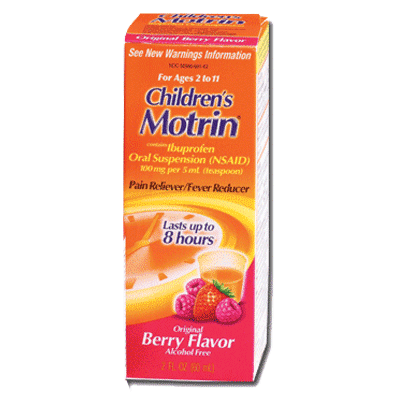 A controversy emerged this week over an alleged agreement between the US Food and Drug Administration (FDA) and Johnson & Johnson subsidiary McNeil HealthCare over a ‘soft’ recall of Children’s Motrin and other products that were thought to be defective due to lax GMP (Good Manufacturing Practice) at one of McNeil’s facilities.
The allegation, if true, suggests that one arm of the FDA doesn’t know what the other is doing. It also appears to suggest—again—that so long as the FDA does not have the mandate to force a drug company to conduct a recall, or do anything it doesn’t want to, for that matter, the federal drug regulator is like a tiger without teeth.
As for the drug companies, it appears as if they subscribe to the credo, “don’t ask permission, beg forgiveness.”
According to documents and testimony at a congressional hearing this week, the FDA had decided that Motrin product, which had been identified as defective due to GMP problems at the facility where it was manufactured, should be subject to a Class 2 recall.
There are various levels of recall identified by the FDA, with a Class 1 as the most serious. The latter is urged if there is a problem that could lead to serious health effects or even death. Class 2 is suggested if the problem could cause temporary, or medically reversible adverse health consequences.
Further, a Class 3 is issued if a product defect is not likely to cause serous health consequences at all.
Then there’s the ‘market withdrawal,’ which according to CNN Money on Tuesday is not a recall Read the rest of this entry »

Find us on


Archive by Category
- Accidents (24)
- Airlines (9)
- Asbestos Mesothelioma (262)
- Automotive (25)
- Celebrity (14)
- Class Action (84)
- Complaints/Comments (15)
- Consumer Fraud (84)
- Contest (2)
- Court of Public Opinion (5)
- Crazy Sh*t Lawyers See (61)
- Criminal Law (4)
- Defective Products (111)
- DePuy ASR Hip Recall (2)
- Discrimination (22)
- Drugs/Medical (248)
- Elder Care Abuse (4)
- Emerging Issues (462)
- Employment (54)
- Environment (52)
- Financial (28)
- Food Illness (15)
- Human/Civil Rights (4)
- Insecurities (5)
- Insurance (16)
- Intellectual Property (16)
- Internet/E-commerce (19)
- lawsuits (161)
- Lawyers (20)
- Lawyers Giving Back (43)
- Lex Levity (10)
- Personal Injury (106)
- Pleading Ignorance (53)
- Real Estate (2)
- Recall (6)
- Scam (3)
- Securities (13)
- Settlement (81)
- Tort Reform (2)
- Totally Tortelicious (81)
- Veterans (11)
- Whistleblower (9)