Posts Tagged ‘ Class Action Lawsuit ’
Hunger Pang Lawsuit: Moose Munch Lacking a Bunch?
February 14th, 2017. By LucyC
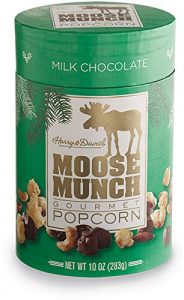 How much air is too much air? Who knows. BUT—we may be about to find out. No, not talking about this blog. Harry & David LLC gourmet foods got slapped with a consumer fraud class action lawsuit over slack fill in their popcorn canisters. There is some small irony here. What is popcorn if not flavored air? Surely that’s why it’s the diet food of choice for so many.
Back to the lawsuit. Filed by New Yorker Bria Brown, the lawsuit claims that an excessive amount of the 10 ounce package of (take a breath) Harry & David Moose Munch Milk Chocolate-flavored Gourmet Popcorn (got all that?) contained empty space—not including the popcorn.
Brown claims that she didn’t receive $7.99 worth of popcorn—expecting—reasonably, I would suggest—that the box would be almost full, if not completely full. Hey, if you’re on a diet, every ounce counts… Not saying Brown was on a diet. But if you’ve just shelled out eight bucks for some flavored popcorn—and you’re hungry—I doubt you’re going to be too pleased to find out you’ve got less food than you expected. Although I’m not sure popcorn is actually considered food. Read the rest of this entry »
Got a Samsung Washer Explosion Story?
September 9th, 2016. By LucyC
 Is the day to day grind getting you down? Fed up with doing the laundry? Try out a Samsung washing machine—it could put a little Kaboom in your life, and your walls and possibly send a family member to hospital. That’d liven things up!
Yup—Samsung has allegedly cornered the market in exploding, top loading washing machines. Unintentionally, of course. But they’re not really owning the whole issue, well, actually, no part of it all. So, a consumer fraud class action lawsuit has been filed. I know, I know, hard to believe. But Samsung cannot not know about this.
A superquick search on Google (that’s the search where Google finishes your sentence—so you know something’s going on) turns up not one, not two—but dozens of reports of these machines literally exploding. If you’re having a hard time imagining that—just wait. And these reports go back to 2015—possibly earlier. People from across the US–one of the latest out of Bandera, TX—have posted their experiences on You-Tube, local news stations have covered the phenomenon, and CPSC is collecting first hand reports. And amazingly enough, this doesn’t seem to have prompted any action at all—not even a recall.
One news source, applicanceertailer.com, ran the headline: “Samsung washing machines now exploding in the US.” What ? So they had finished their run in Europe? (who writes this stuff?)
One woman counts herself lucky, as she admitted watching her machine at work—literally standing over the glass lid—before it blew itself up. Actually, to be accurate, it blows its sides out, shakes the walls, causing shelving to jiggle and ornaments and pictures to fall. People have thought it was a canon going off, or an earthquake. But there are far worse accounts.
To quote the Applianceretailer.com story…
“The washing machine claimed to have “suddenly and without warning” violently exploded as it completed its final minutes of high-speed spin cycle.” Didn’t know the washing machine could speak as well, but hey—wouldn’t put much past these things.
The article goes on…
“The [Consumer Product Safety Commission] report reads, “The washer lid flew off the machine and slammed into the consumer on her lower back, causing the consumer to collide into a cabinet, where she struck her head, neck, upper body, chin and jaw.
“The entire washer lifted as much as six inches off the ground, spun 180 degrees, striking the consumer, damaging the wall and side of the dryer.”
Holy crap. Not to make light of the situation, but that sounds “Exorcist” worthy. Maybe they’re not defective, but possessed?
The article sites another two CPSC reports, one in which a consumer experienced not one but two explosions “that were felt across the entire house…” The story states that “A safety health and environment professional reported that “all technicians, safety professionals, engineers and laymen were completely impressed with the level of carnage.” Well then. An unfortunate choice of phrasing, but we take their meaning.
The other report indicates that the entire machine exploded and burst into pieces. “The entire top of the unit separated and flew into our hallway, and the unit continued to spin violently around the laundry room, ripping holes in our walls, dryer, cabinets and flooring.” Ok—that’s impressive. At some point you might start to wonder what you put on your Shreddies that morning.
So, no recall, several lawsuits, and some pretty alarming stories.
Wonder what happened to the clothes?
If you’ve experienced your own, personal Samsung exploding washing machine event—we’d love to hear from you.
Flashback Friday! Volkswagen Ads post-Volkswagen Lawsuits?
September 25th, 2015. By AbiK
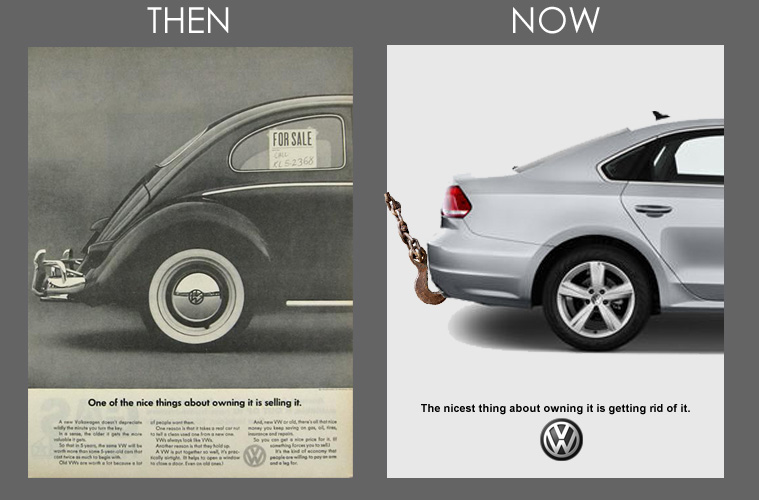
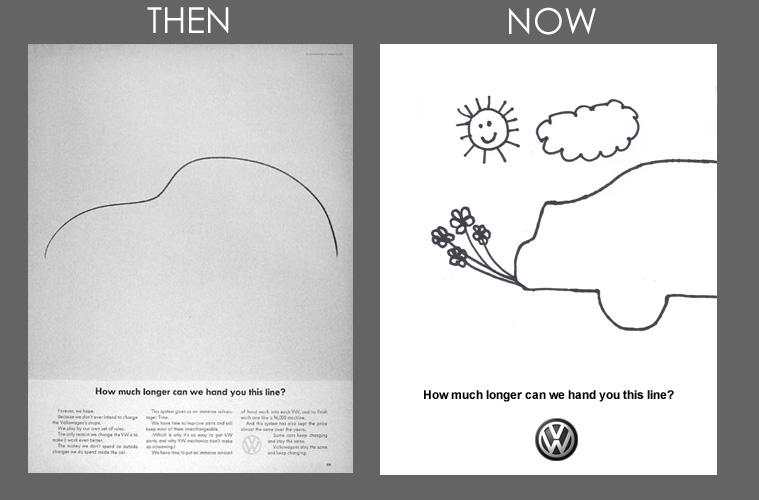
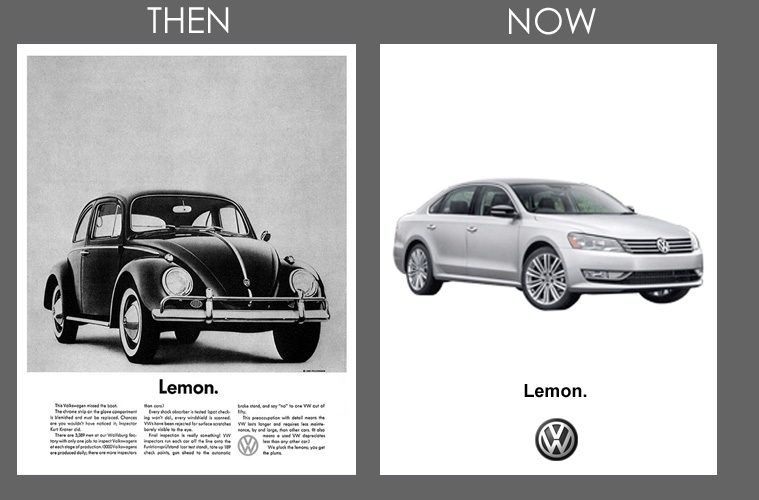
Yes, it’s time for a flashback Friday! Remember all those great Volkswagen ads of years gone by? Simple. Witty. Dare I say…trustworthy. Best of all, they poked humor at themselves. They totally got how folks were like “wtf??” when they saw a car that resembled something you’d step on in a heartbeat. And they ran with it. Yesiree…totally ran—straight to the bank. And flower children everywhere made the VW Bug the automotive emblem of their age. Complete love-fest.
But that was then. Fast-forward to September 18, 2015 when news broke about something called a “defeat device“. It sounded like something you’d grab in Minecraft to kill the Ender Dragon—but alas, it turned out to be much more sinister. As we all now know, it’s what VW installed in its diesel autos to suppress emissions so that the cars would pass emissions testing on a dynamometer—aka a stationary “rolling road” used to test cars (and no, we didn’t know what that was either until a week ago). Those emissions, however, when on an actual road, were spewing upwards of 40x more toxic fumes than permitted. Uh-oh! Where’s the love now folks? To die-hard VW fans, it’s a jilt they’ll never get over.
And now there’s a stack of Volkswagen lawsuits piling up.
But it’s worth looking back…at some of those VW ads of yore, and imagining those same ads circa 2015. Yes, the ads on the right are totally fake–just to be clear. But it’s easy to see how they could well be art imitating life right now… so here goes…
Top 10 Legal News Stories of 2013
January 7th, 2014. By AbiK
 Bet you can’t guess what the top legal news story on LawyersandSettlements.com was for 2013 (and no, none of them featured former NYC mayoral hopeful Anthony Weiner…).
I’ll take that bet even further—I bet most attorneys, who you’d think would be in the know on these things, couldn’t even guess.
That’s because 2013 turned out to be a pretty interesting year in terms of the top legal news stories our journalists covered. While employment lawsuits—typically involving issues such as unpaid overtime and misclassification, on-the-job discrimination, workers’ comp, and wrongful termination—are always reader faves, in 2013 something strange happened: employment issues did not show up in our top ten news stories. At all.
Go figure, eh?
To be fair, when it came to content posted other than legal news articles (i.e., emerging issues, settlements, lawsuits filed), employment settlements drew the most readers. But it was health-related issues that drove readers’ interest when it came to articles and interviews. Here’s how the year’s top ten legal news stories played out (as measured by number of clicks the articles published in 2013 received):
1. Denied Disability: Social Security Recognizes Fibromyalgia
2. Health Canada Documents Link Yasmin and Yaz to Deaths
3. Are Fen-Phen Pills Back? You Would be Half-Right…
4. New York State Cracks Down on Illegal Internet Payday Loans
5. Mirena User Suffers Miscarriage, Now Filing Mirena Lawsuit
6. Mirena Side Effects Lead to Early Hysterectomy for Young Plaintiff
7. Monster Caffeine Levels: When Too Much Energy Isn’t Good for You
8. Junior Hockey League Player Filing Ulcerative Colitis Accutane Lawsuit
9. Yasmin Birth Control Suspected in Deaths of Canadian Teens
10. Mesothelioma Victim Awarded $8 Million
And if you’re wondering what the number one legal news story was for 2012…here’s that one (and, you guessed it, it was about a wage and hour lawsuit, the ‘Lunch Break Lawsuit‘ (Brinker Restaurant Corp. v. Superior Court))
Judge To Hearst Interns: Sorry, Sue for Yourself; No Class Action Lawsuit Here
May 14th, 2013. By AbiK
 Was this any surprise? The one-time Hearst intern, Xuedan Wang, aka Diana Wang—who sued Hearst (Xuedan Wang v. The Hearst Corporation, U.S. District Court for the Southern District of New York, No. 12cv793) claiming that she and other interns at the various Hearst magazines were unfairly misclassified—has not been granted the class action lawsuit status she was after.
Wang’s initial lawsuit claimed that her unpaid internship at Harper’s Bazaar violated the federal Fair Labor Standards Act (FLSA) and New York state labor laws. (For the record, the U.S. Labor Department states that unpaid internships must be educational and “for the benefit of the intern.”)
Now, forget about the fact that many of us have done internships and we completely “got” what we willingly signed up for: on-the-job training for zero (or very low) pay and a nice addition to a resume. What Wang’s complaint stated was that, “Unpaid interns are becoming the modern-day equivalent of entry-level employees, except that employers are not paying them for the many hours they work.” Earth to Wang et al, internships at top magazines in NYC—as well as at many other places—have always been about entry-level tasks being performed by unpaid wannabes. It’s a tit-for-tat arrangement—the company gets some help, the intern scores experience and a credential. No one promised glamour and prestige—or any pay.
So somewhere along the path from Baby Boomer, to Gen X, to Gen Y/Millennials, it would appear the definition of “intern” has changed. Here are some (non-legal) definitions from Merriam-Webster and TheFreeDictionary.com, respectively, as the word relates to labor:
- an advanced student or graduate usually in a professional field (as medicine or teaching) gaining supervised practical experience (as in a hospital or classroom)
- someone, as a student or recent graduate, working as an apprentice or trainee to gain practical experience in an occupation
Seems an intern gets “practical experience”. No mention of a paycheck. And, might I add, if a paycheck were what Wang et al were after, here’s a tip: apply for a job. (fyi, here’s Merriam’s definition of “job”: “a piece of work; especially : a small miscellaneous piece of work undertaken on order at a stated rate” —note the words “stated rate”).
But, of course, why pay your dues in a highly competitive industry when you can try to file a class action lawsuit because, unlike the millions of interns who preceded you, YOU are special? Btw, if that sounds jaded or sarcastic—note that according to a Facebook page dedicated to Wang’s intern class action lawsuit attempt, she “worked seven unpaid internships before she got fed up.” SEVEN folks. At that rate, it’s kind of hard to point the finger at anyone else but Wang—and it starts to look like maybe she needed some career coaching.
If you don’t think living a fashion intern’s “Groundhog Day” x7 reveals enough about Wang’s (insert “misguided”?) approach to breaking into the glam world of haute couture and ready-to-wear, check out these Wang quotes from a NY Magazine article, “The Norma Rae of Fashion Interns”, that ran when the class action was initially filed (apologies to the real Norma Rae, Crystal Lee Sutton)—the quotes hint at a sad naivete about not only working in fashion, but also about work in general:
“I’d been dreaming of standing in their offices for fifteen years,” she says. “I was so ready to give everything I had. I couldn’t imagine that the dream of mine was becoming real.”
“This was going to be my only ticket to the industry,” she says. “I didn’t have unlimited resources. I was going to make the time worthwhile. I was going to be remembered by people.”
“I was so uncomfortable and stressed out,” she says. “It was hard to get people to understand how an intern could be stressed out, but the editors constantly stressed that this was a real job and if this went wrong or if that happened, it would be my fault.
Kind of makes you think of that sad sack who’s putting all his hopes and dreams on that one Powerball lottery ticket…sure you gotta be in it to win it, but you also have to have a realistic view of your chances.
Regardless of all that, this is indeed, about a class action lawsuit and as such, it needed to go through the rigorous review for certification. And that means that from a legal perspective, in order for there to be a “class” established for the lawsuit, certain requirements need to be met: numerosity, commonality, typicality and adequacy of representation.
According to Reuters, the judge who presided over the employment misclassification filing, U.S. District Judge Harold Baer, found that the “former interns failed to meet the bar set out in the Supreme Court’s landmark 2011 case Dukes v. Wal-Mart to constitute a class action. Specifically, Baer found that the interns did not meet the standards of commonality and predominance needed to be considered a class.”
How so?
Baer explained in his decision, “Here, while a close question, the commonality requirement is not satisfied because plaintiffs cannot show anything more than a uniform policy of unpaid internship.” That included the fact that the interns in the proposed class worked for different magazines and performed different tasks. Reuters reports that Baer also denied the plaintiffs’ motion for summary judgment on whether they met the definition of an employee.
So what now?
Well, Wang et al can now try to sue Hearst individually—not as a class. Though it’s unlikely that many will choose to do so as the interns were seeking minimum wage—and the cost to litigate such a case for a net return of minimum wage minus attorney fees is probably just not worth going to the mat for…

Find us on


Archive by Category
- Accidents (24)
- Airlines (9)
- Asbestos Mesothelioma (262)
- Automotive (25)
- Celebrity (14)
- Class Action (84)
- Complaints/Comments (15)
- Consumer Fraud (84)
- Contest (2)
- Court of Public Opinion (5)
- Crazy Sh*t Lawyers See (61)
- Criminal Law (4)
- Defective Products (111)
- DePuy ASR Hip Recall (2)
- Discrimination (22)
- Drugs/Medical (248)
- Elder Care Abuse (4)
- Emerging Issues (462)
- Employment (54)
- Environment (52)
- Financial (28)
- Food Illness (15)
- Human/Civil Rights (4)
- Insecurities (5)
- Insurance (16)
- Intellectual Property (16)
- Internet/E-commerce (19)
- lawsuits (161)
- Lawyers (20)
- Lawyers Giving Back (43)
- Lex Levity (10)
- Personal Injury (106)
- Pleading Ignorance (53)
- Real Estate (2)
- Recall (6)
- Scam (3)
- Securities (13)
- Settlement (81)
- Tort Reform (2)
- Totally Tortelicious (81)
- Veterans (11)
- Whistleblower (9)