Posts Tagged ‘ birth defects ’
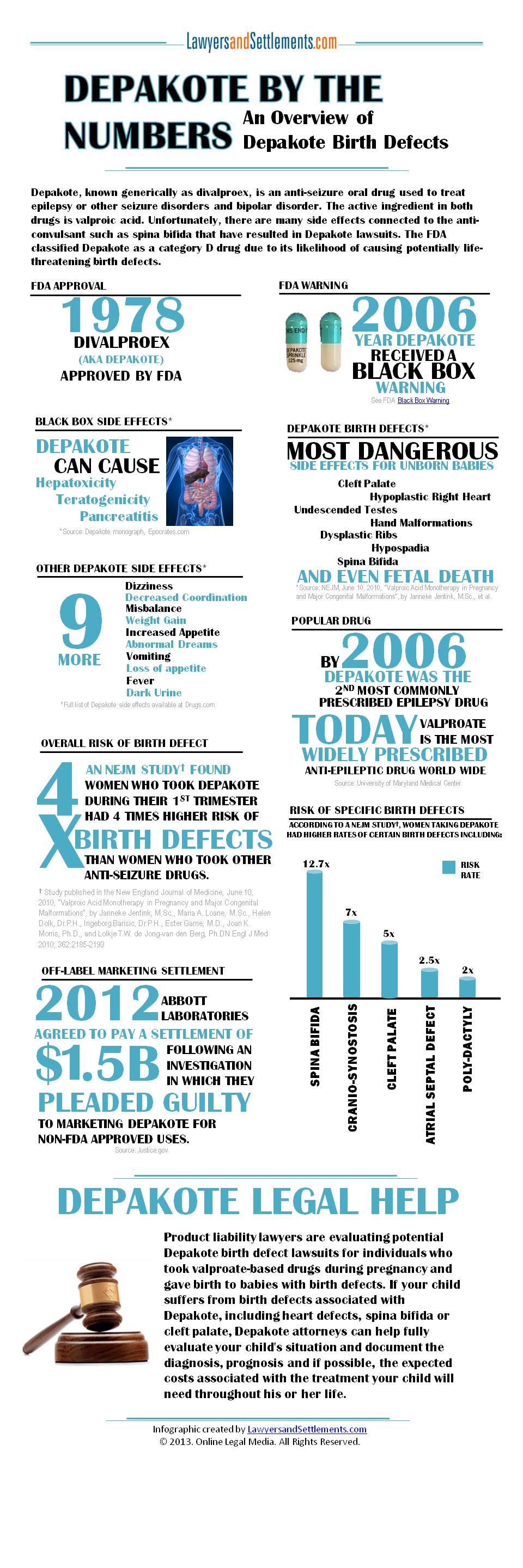
Infographic: Depakote Birth Defects, Off-Label Marketing by the Numbers
March 1st, 2013. By AbiK
Recently, a small British study that was published in the Journal of Neurology, Neurosurgery & Psychiatry (1/30/13), suggested women who take valproate while pregnant have an increased risk of having children with autism and neurodevelopment problems. The study also suggested that damage to the fetus happens during the early stages of pregnancy.
Valproate-based anti-convulsants (drugs used to treat seizure disorders including epilepsy) include brand-name drugs Depakote, Depakene, Depacon and Stavzor–all of which are pregnancy risk Category D drugs. Category D drugs have shown positive evidence of fetal risk based on adverse reaction data from investigation or marketing experience or clinical studies in humans.
The Depakote infographic below highlights some of the potential adverse effects in newborns that have been associated with taking Depakote during the first trimester of pregnancy.
Top 10 Drugs with Heart Side Effects on LawyersandSettlements.com
January 31st, 2012. By AbiK
 In recognition of American Heart Month, which kicks off tomorrow (Feb. 1st), and National Wear Red Day (Feb. 3rd), LawyersandSettlements.com takes a look at our most-viewed drug lawsuit topics for 2011 in which heart attack or heart side effects were the alleged primary injuries.
Unfortunately, while a lot of focus this month will be on the positive measures we all can take to improve heart health—and that’s certainly important—it can be easy to overlook the negative heart side effects some drugs can have—and attention should be given to those as well.
As the chart at left depicts, Actos, Paxil and Zoloft accounted for the majority of 2011 traffic related to heart side effects, with Actos receiving the most at 25 percent. The Type 2 diabetes drug was released as an alternative to Avandia, which as you’ll recall came off pharmacy shelves as a result of the new FDA REMS program that became effective in November, 2011. Still, Avandia came in as the fourth most popular heart lawsuit topic.
Paxil, the popular antidepressant, has been linked to heart birth defects in infants and the drug drove in 18 percent of traffic last year. Ditto Zoloft, which accounted for 10 percent of the pageviews among readers concerned over the potential for heart birth defects.
The ten prescription drugs on the list fall into four distinct classes: Actos and Avandia are prescribed for the treatment of Type 2 Diabetes; Vytorin helps to control cholesterol, which has a direct impact on heart health; Trasylol is used during surgery to mitigate blood loss; the remaining drugs address depression and anxiety.
Reader interest in Prozac, Lexapro, Effexor, Celexa, Zoloft and Paxil shows continued concern surrounding pregnant women using selective serotonin reuptake inhibitors (SSRI) drugs and potential heart birth defects.
Here’s the full list:
Top 10 Drug Lawsuit Topics for Heart Side Effects in 2011
- Actos (Pioglitazone HCl)
- Paxil (Paroxetine)*
- Zoloft (Sertraline)*
- Avandia (Rosiglitazone)
- Celexa (Citalopram)*
- Effexor (Venlafaxine)*
- Lexapro (Escitalopram)*
- Prozac (Fluoxetine)
- Trasylol (Aprotinin)
- Vytorin (Ezetimibe/Simvastatin)
*SNRI (serotonin-norephinephrine reuptake inhibitor) or SSRI (selective serotonin reuptake inhibitors) drugs associated with heart birth defects when taken during pregnancy
Perfect Valentine’s Day Gift? Go for Glee with Phthalate Free
February 11th, 2011. By Hunter West
 Can we talk?
Okay, Valentine’s Day is coming up on Monday and much as we like to think that the Big Red Day is all about flowers and chocolates, gushy Hallmark cards and little else, sex toy and adult novelty shops do a booming business leading up to Valentine’s Day.
No, you don’t have to close your eyes. It’s not like we have samples. But face it, for some people nothing says ‘I love you’ like a big piece of rubber…even better if it glows in the dark.
Which brings us to health issues. In January the National Post up in Canada carried a story about the Canadian sex toy retail industry crying foul over the fact that Health Canada does not regulate phthalates in adult sex toys in the same fashion as children’s toys.
(We believe the same is true in this country, but of course Canadians are much more randy this time of year than we are—what else is there to do up there when the snow banks are higher than your Honda and it’s ten below zero outside? Ya know why they won all those medals in the Olympics last year, don’t you? All those indoor sports…).
Health Canada, the Canadian health regulator akin to the US Food and Drug Administration (FDA) in this country, announced last month that it was putting new restrictions in place that would lower concentrations of six phthalates by June of this year. Lest you think ‘phthalate’ is a new position you haven’t tried yet, in reality it’s a chemical that is used to make rubber compounds soft and squishy—which is the last thing you want to have happen in the real experience but quite acceptable in sex toys.
All kidding aside, the gurus at Health Canada have a point. Phthalates have been voluntarily removed from pacifiers and baby bottle nipples for some time due to personal injury concerns about the risks associated with phthalates and reproduction and development of children less than four years of age.
To that end, it has been determined, according to the National Post, that objects do not release phthalates merely through touch. However, they can release the vilified chemical into saliva when a child sucks on a pacifier.
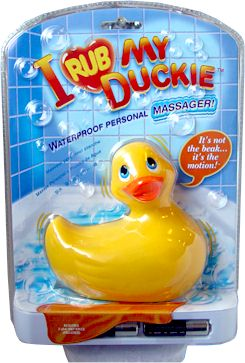
Or, for that matter, anything the child is playing with. To that end, a rubber duckie is not designed to go into a child’s mouth. However, putting things in their mouths is what children do—including rubber duckies and anything made of soft rubber into which phthalates are injected to make then soft. (By the way, according to Big Teaze Toys (tagline, “Toys that Play with You”), I Rub My Duckie (shown) is not only phthalate free, but has appeared on The View. And no, this isn’t an endorsement).
Manufacturers thought they were doing the kids a favor by taking out the rigidity of rubber, so Read the rest of this entry »
Grassley Seeks More Info on Conflict of Interest Policies at Medical Schools
June 25th, 2009. By Evelyn Pringle
In a June 24, 2009 letter, Senator Chuck Grassley asked 23 medical schools for information about their policies for conflicts of interest and requirements for disclosure of financial relationships between faculty members and the pharmaceutical industry.
“I recently learned from an American Medical Student Association report, AMSA PharmFree Scorecard 2009, that your institution either had “no response” or “declined to submit policies” when asked to supply conflicts of interest policies,” he said in the letter.
Grassley asked the Universities to respond by no later than July 15, 2009.
Of the 149 schools asked, 126 provided information to the AMSA. The Scorecard 2009 was released on June 16, 2009. Thirty-five schools, or 23%, received an F. Seventeen got a D, 18 received a C, 36 were graded B, and only 9 schools received an A.
“There’s a lot of skepticism about financial relationships between doctors and drug companies,” Grassley said in a press release. “Disclosure of those ties would help to build confidence that there’s nothing to hide.”
“Requiring disclosure is a common sense reform based on the public dollars and public trust at stake in medical training, medical research and the practice of medicine,” he added. Read the rest of this entry »

Find us on


Archive by Category
- Accidents (24)
- Airlines (9)
- Asbestos Mesothelioma (262)
- Automotive (25)
- Celebrity (14)
- Class Action (84)
- Complaints/Comments (15)
- Consumer Fraud (84)
- Contest (2)
- Court of Public Opinion (5)
- Crazy Sh*t Lawyers See (61)
- Criminal Law (4)
- Defective Products (111)
- DePuy ASR Hip Recall (2)
- Discrimination (22)
- Drugs/Medical (248)
- Elder Care Abuse (4)
- Emerging Issues (462)
- Employment (54)
- Environment (52)
- Financial (28)
- Food Illness (15)
- Human/Civil Rights (4)
- Insecurities (5)
- Insurance (16)
- Intellectual Property (16)
- Internet/E-commerce (19)
- lawsuits (161)
- Lawyers (20)
- Lawyers Giving Back (43)
- Lex Levity (10)
- Personal Injury (106)
- Pleading Ignorance (53)
- Real Estate (2)
- Recall (6)
- Scam (3)
- Securities (13)
- Settlement (81)
- Tort Reform (2)
- Totally Tortelicious (81)
- Veterans (11)
- Whistleblower (9)