Personal Injury Archive
The WATCH list: Top 10 Worst Toys for Child Danger
November 25th, 2016. By LucyC
 Well folks, it’s that time of year again. I’m referring to toy shopping. After all, some of the hottest deals for holiday shopping start approximately 2.8 seconds after the turkey’s been devoured. And if it’s you who’s tasked with finding that perfect, most desirable toy this year, there are a few things you might want to be aware of before heading out the door (or to your keyboard).
The consumer watchdog group, appropriately called “The World Against Toys Causing Harm Inc., (WATCH) – has compiled a list of the world’s most dangerous toys that, obviously, parents would be wise not to buy.
As their name indicates, the WATCHdogs aren’t fooling around. They note that more than 800,000 toys have recalled since January 2015, with more than 500,000 of those toys having being pulled from the market just this year. There’s been a 40 percent increase in toy-related injuries from 1990-2011. AND, are you sitting down—WATCH also notes that one child is treated in the US emergency rooms every three minutes for a toy-related injury. More than 60 children were killed in toy related incidents between 2010 and 2014.
Ok—so now I have your attention, and just in time for Black Friday, WATCH has issued a list of their nominees for top 10 toys to be avoided (the names are a bit of a giveaway). Choking hazards seem to feature prominently, as do other serious injuries.
Specifically, Peppa Pig’s Muddy Puddles Family, and the Baby Magic Feed and Play Baby can both, allegedly, provide risk for choking, but neither carries the appropriate warnings. So, if these toys had a warning for choking, would that make it ok to sell them? Just asking.
Then there’s the Kids Time Baby Children’s Elephant Pillow, which also apparently does not have a warning for the risk of suffocation. Again, if it carries a warning, does that make it ok?
The Slimeball Slinger, which, according to WATCH, is a slingshot type of thing that can be fired from over 30 feet. Great. Not surprisingly, it poses a risk of eye injury, never mind family pets, windows and china cabinets.
The Banzai Bump n’ Bounce Body Bumpers allegedly have the potential to cause impact injuries and do not come with protective helmet, knee guards or other protective equipment. Maybe those items are sold separately?
The Nerf Rival Apollo XV-700 Blaster, allegedly has the potential to cause eye injuries.
The Good Dinosaur Galloping Butch was included because it failed to warn that the pointy, rigid tail of the dinosaur can puncture children’s skin.
Peppy Pups, which could cause strangulation in young children due to a pull string measuring 31 inches. Yikes.
The Flying Heroes Superman Launcher also poses a hazard from eye injury from the items launched from the toy.
And finally, The Warcraft Doomhammer made the list allegedly due to its heavy, rigid hammer than can inflict bodily harm if children use the toy as a weapon, (what else is this meant to be used for, given the name?). Apparently the Doomhammer is similar to seen in the video game or in the movie. Is World of Warcraft PG rated? Seriously?
If you’re interested in learning more about these and other potentially dangerous toys, you can view the list at http://toysafety.org/
That about covers if for now. Happy shopping.
Finding a Good Lawyer Sucks – PART 1
February 11th, 2014. By AbiK
 This one may get ugly…it’s the personal saga of yours truly as I embark on the process of hiring the right personal injury attorney—for real! The attorneys I’m reaching out to do not know I work for a legal news website. So I’ve got no special “in” here and will live this process just as everyone who clicks that “submit claim” button does. Only, to be fair, I’m not submitting a claim here, where I work. Ready to come along for the ride?
The Beginning: I think I need a lawyer.
It happens. One day, you say the words, “Maybe I should talk to a lawyer.” There’s an uneasiness in your stomach as the words flow from your lips. But you’ve reached that point where, for whatever reason, you need—and are ready to pursue—legal help.
You might think your next step would sort of be like what you’d do if, instead, you had said something like, “Guess I need to get the car checked.” No. That would be too easy: Pick up the phone. Schedule a time to bring the car in. Done. A pain in the a$$, but easy.
No. When you need to find a good lawyer, you start to feel more the way Rose might in a Dr. Who episode—you know, the parts when she’s all like “But why Doc-tuh?…Doc-tuh?…Doc-TUH?!?” And there’s Rose standing helpless and clueless in the middle of some street while “Doctuh” has disappeared.
And I’m not talking about trying to find your run-of-the-mill divorce lawyer or the lawyer who writes up your will. No disrespect to those folks—but their work, while important and at times quite messy, is pretty straightforward. You know the end goal and pretty much how to get to it. And, chances are, you can get a few good referrals right from your circle of friends. No, I’m talking about needing a personal injury attorney. Things start to get murky when you’re in the land of “harm”, “damages”, “wrongdoing”, and the ever-popular “pain and suffering”.
So here I am, muttering that “get a lawyer” phrase and…I’m stymied. Yep. Don’t know where the hell to start. And here’s the part I want y’all to remember: I WORK IN THE LEGAL INDUSTRY. So for those of you who do not, and who are either on this journey or have been on it, please know I have no special “in” that I’m using and yes, I really am feeling your pain. Really.
Now, before you even get to picking up your mobile to dial 1-800/888/877/866-INJURY-NOW or whatever cute & catchy vanity phone number you saw as you blew by that billboard on Route You-Name-It, you hesitate. You don’t even know if you SHOULD call an attorney, right?
Maybe you’re overreacting. Being a bit prickly. A wuss. After all, people (the media?) always tend to show potential plaintiffs in the worst light: we’re all opportunists (hot coffee lawsuit anyone?). Or, we just don’t suck it up. So there’s that stigma to reconcile with yourself at the outset. And let’s face it, most people really don’t want to be litigious. It’s too…confrontational.
Then, there’s all that imagery of advanced learning—framed certificates of this or that, suits & ties, mahogany everywhere and built-in bookcases with series upon series of books that all have that same monotonous red & gold leaf binding. Who are these people? And who the hell wears a suit all the time anymore?
It’s off-putting. You feel self-conscious, insignificant, daunted and on the defensive before you’ve even opened your mouth or shaken any hands. Why is it that those legal help billboards scream “Come On In!” and yet for some reason you still don’t feel that welcome feeling? As someone whose background is in marketing—yea, I drank the “consumer’s always right!” kool-aid and am a strong believer in transparency—if I had the option to shop elsewhere for legal help—for example, maybe my mother-in-law who’s been known to put up a good fight (and has no problem stating her mind) would like to represent me. I’d get her on contingency. But there’s that lousy requirement about being admitted to the bar. Excuse me, The Bar.
So here we go. I’ve weighed the pro’s and con’s—as much as I know of what those could possibly be—and I’ve decided to go for it. I’m going to find an attorney! I’m going to right the wrong!
Not so fast.
You thought you’d walk into the lawyer store and pick one off the shelf, eh? Thought they’d have your fit, size and color right there for the taking? Silly you. Well, actually, not silly you–after all, that’s sort of how you find a doctor, right? You figure out what part of you ails and you get a doctor who works on that part.
Ahh, but just try to let your fingers do the walking in the Yellow Pages (online edition, of course) for a lawyer, it’s not like they’re listed by the lawsuits they work on. Go ahead and see for yourself. Search for “lawyer” and you’ll be given some options to further filter your search. One of those options is “Personal Injury Attorney”. Think you’ve found your match? Think again!
No—the lawyer who argues the case about Yaz birth control is NOT the same guy (or gal, we don’t discriminate here) who argues your wrongful termination case and is NOT the same guy/gal who even might argue your egress/regress employment issue! And see—I’ve already started with the jargon—WTF is egress/regress?!? (Yes, I know what it is…I’m making a point.)
That will be your first surprise. Which you won’t necessarily know unless you actually MAKE CONTACT with someone at the law firm you’re trying to connect with, and they tell you in so many words that you’ve got the wrong address (aka, the proverbial “I don’t really handle those cases” line that tells you you’re not welcome there, but does not quite tell you where you should be.)
Frustrated yet? And you’ve only just begun (nod to The Carpenters).
So, first, you need to know what your problem is. It’s not all that difficult, but no one REALLY explains that well up front. So, if it’s employment-related, you need an employment lawyer (in your state of employment, I might add). If it’s a medical device problem, you need a medical device attorney. Tracking with me? Good.
So that’s where I am in this process. I’ve figured out my problem, figured out the kind of attorney I’m looking for, and now I’ve started to reach out to them. IMPORTANT NOTE: The easiest/best thing for me to do would be to submit a claim form to request legal help right here on LawyersandSettlements.com (shameless plug)—after all, my claim would go to at least three good lawyers—shotgun style! I like that! But, again, that would be too easy and I don’t sh*t where I eat… So I’m out on the “open market”, so to speak.
I won’t name names throughout this process. But come along with me and we’ll share our pain. And we’ll ask the question (quite often I might add): Why is it so hard to find a lawyer? And maybe, just maybe, we’ll make it better somehow.
Stay tuned.
Top 10 Legal News Stories of 2013
January 7th, 2014. By AbiK
 Bet you can’t guess what the top legal news story on LawyersandSettlements.com was for 2013 (and no, none of them featured former NYC mayoral hopeful Anthony Weiner…).
I’ll take that bet even further—I bet most attorneys, who you’d think would be in the know on these things, couldn’t even guess.
That’s because 2013 turned out to be a pretty interesting year in terms of the top legal news stories our journalists covered. While employment lawsuits—typically involving issues such as unpaid overtime and misclassification, on-the-job discrimination, workers’ comp, and wrongful termination—are always reader faves, in 2013 something strange happened: employment issues did not show up in our top ten news stories. At all.
Go figure, eh?
To be fair, when it came to content posted other than legal news articles (i.e., emerging issues, settlements, lawsuits filed), employment settlements drew the most readers. But it was health-related issues that drove readers’ interest when it came to articles and interviews. Here’s how the year’s top ten legal news stories played out (as measured by number of clicks the articles published in 2013 received):
1. Denied Disability: Social Security Recognizes Fibromyalgia
2. Health Canada Documents Link Yasmin and Yaz to Deaths
3. Are Fen-Phen Pills Back? You Would be Half-Right…
4. New York State Cracks Down on Illegal Internet Payday Loans
5. Mirena User Suffers Miscarriage, Now Filing Mirena Lawsuit
6. Mirena Side Effects Lead to Early Hysterectomy for Young Plaintiff
7. Monster Caffeine Levels: When Too Much Energy Isn’t Good for You
8. Junior Hockey League Player Filing Ulcerative Colitis Accutane Lawsuit
9. Yasmin Birth Control Suspected in Deaths of Canadian Teens
10. Mesothelioma Victim Awarded $8 Million
And if you’re wondering what the number one legal news story was for 2012…here’s that one (and, you guessed it, it was about a wage and hour lawsuit, the ‘Lunch Break Lawsuit‘ (Brinker Restaurant Corp. v. Superior Court))
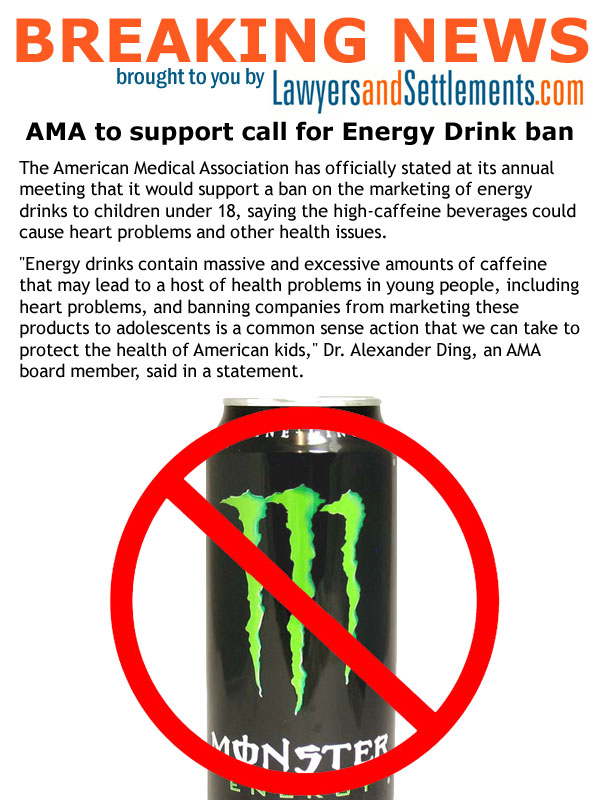
Under 18 Energy Drink Ban Gets AMA Support
June 19th, 2013. By AbiK
Law News For You: Energy Drink ER Trips Skyrocket
June 18th, 2013. By AbiK

Find us on


Archive by Category
- Accidents (24)
- Airlines (9)
- Asbestos Mesothelioma (262)
- Automotive (25)
- Celebrity (14)
- Class Action (84)
- Complaints/Comments (15)
- Consumer Fraud (84)
- Contest (2)
- Court of Public Opinion (5)
- Crazy Sh*t Lawyers See (61)
- Criminal Law (4)
- Defective Products (111)
- DePuy ASR Hip Recall (2)
- Discrimination (22)
- Drugs/Medical (248)
- Elder Care Abuse (4)
- Emerging Issues (462)
- Employment (54)
- Environment (52)
- Financial (28)
- Food Illness (15)
- Human/Civil Rights (4)
- Insecurities (5)
- Insurance (16)
- Intellectual Property (16)
- Internet/E-commerce (19)
- lawsuits (161)
- Lawyers (20)
- Lawyers Giving Back (43)
- Lex Levity (10)
- Personal Injury (106)
- Pleading Ignorance (53)
- Real Estate (2)
- Recall (6)
- Scam (3)
- Securities (13)
- Settlement (81)
- Tort Reform (2)
- Totally Tortelicious (81)
- Veterans (11)
- Whistleblower (9)