Human/Civil Rights Archive
The Kid’s Alright: #FreePatBrown if you Believe in Freedom of Speech
May 29th, 2013. By AbiK
 This kid’s onto something. Unfortunately, he’s also out of something: school. He was apparently suspended for exercising his First Amendment rights. Here’s the story…
Pat Brown is young. He’s engaged. No, not as in heading to the altar—he’s socially aware and he’s participating in the dialog about his local school board budget. That would be the Cicero-North Syracuse (CNS) High School 2013-2014 budget, which hasn’t yet passed—it was rejected by voters last week.
Pat Brown, student at CNS High, is a concerned student; and he should be—according to a report at CNN, the CNS school board had warned that if the budget isn’t passed, cuts would be necessary—to things like athletic programs, extra-curricular activities and even the elimination of some teacher positions. Things that create and support a robust learning environment for students.
Pat Brown is just a kid—he’s 18, but for all intents and purposes, he’s a high school kid. But he employed the one thing—most likely the only thing—that he could to make his voice, and the voice of his fellow students, heard: he created #shitCNSshouldcut. Humorous, in a shitmydadsays kind of way? Yes. A welcome mat for a wide range of both constructive and negative suggestions? Absolutely. But he achieved the most important thing—he got the conversation going and undoubtedly helped raise awareness among the budget’s main constituency, the student body of CNS High.
But the story doesn’t end there. Sure there were tweets using the hashtag. You can imagine the range of comments—but what really set this story in motion is that Brown, himself, tweeted that CNS High’s executive principal should be let go. And that was apparently a no-no. Result? A three-day suspension for Brown. According to his own Twitter stream, he’s out till this Thursday (5/30).
Now, what’s interesting here is that while some reports indicate that Brown was on his cell phone in class—which in many schools would lead to some form of disciplinary action, though perhaps not immediate suspension—that doesn’t appear to be the impetus for the suspension. According to the CNN article, Brown says he was “called into the office and told he would be suspended for three days for harassing the principal, using a mobile phone in class and disrupting the learning environment.”
There’s the key: “harassing the principal”.
Harassing? It was Brown’s personal opinion that the executive principal is not performing up to snuff. He tweeted it. Unless there’s a serious chunk of the story that isn’t being reported, that doesn’t sound like harassment—it sounds like free speech.
Earlier, I said this kid is onto something. Here’s evidence of that—he tweeted this on May 25th:
“People who are comparing this to me insulting my future employer need to realize one thing…I do not work for my principal.”
You got that right. It’s taxpayer dollars that are paying the school administration’s and teacher’s salaries. And it’s not the principal who determines how the U.S. Constitution is to be interpreted (shameless plug: that would be for trial lawyers and the USSC to handle.)
Given that, perhaps the best suggestion for a CNS school budget cut came from @Rant_rant_rant:
“#shitcnsshouldcut Cut U.S. History classes, since the North Syr. school district no longer acknowledges the Constitution.”
Of course, I’m being facetious. But the tweeter’s got a point.
We’ll have to see where this story nets out, but in the meantime, a new hashtag has emerged: #FreePatBrown.
Sex Offenders Have a Right to be on Social Media! (so says Indiana)
January 30th, 2013. By AbiK
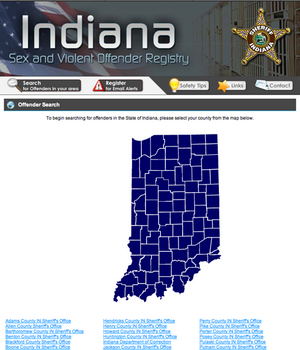 Newsflash: An Indiana court has ruled that it’s unconstitutional to ban sex offenders from using social media sites (like Facebook).
Question: Don’t a lot of kids use social media sites (like Facebook)?
Yes, upon being hit with a civil rights class action lawsuit—filed by the American Civil Liberties Union (ACLU) of Indiana on behalf of sex offenders—the 7th U.S. Circuit Court of Appeals in Chicago overturned a decision made last June that upheld an Indiana law barring most registered sex offenders from using social networking websites.
The law had been in place since 2008—and, according to a press release issued by the ACLU-IN, Indiana already has a law that prohibits inappropriate communication with children, which in theory would cover social media.
The ACLU of Indiana had argued that the ban was so broad that it prevented someone who might have been convicted of an offense years ago from engaging in even innocent conversations on social media channels. This meant that a sex offender could not only not engage in conversation on Facebook, but also could not post a resume on LinkedIn, or as Ken Falk, legal director for the ACLU-IN was quoted as pointing out, “It would even bar someone who was convicted 40 years ago from participating in a Twitter feed with the pope.”
Now, given the amount of press on alleged predatory behavior within the church over the past few years, I’m not sure Mr. Falk used the best social media example—go ahead and cock your head to the side and raise an eyebrow as you ponder that one for a minute—go ahead, I’ll wait for you.
Now admittedly, I haven’t studied recidivism among sex offenders, but I do ascribe to the “leopards don’t change their spots” view of life—for the most part. Here, however, are some stats from the Bureau of Justice Statistics on sex offender recidivism for sex offenders who were released from prison in 1994:
Presents, for the first time, data on the rearrest, reconviction, and reimprisonment of 9,691 male sex offenders, including 4,295 child molesters, who were tracked for 3 years after their release from prisons in 15 States in 1994. The 9,691 are two-thirds of all the male sex offenders released from prisons in the United States in 1994. The study represents the largest followup ever conducted of convicted sex offenders following discharge from prison and provides the most comprehensive assessment of their behavior after release.
Highlights:
- Within 3 years following their release, 5.3% of sex offenders (men who had committed rape or sexual assault) were rearrested for another sex crime.
- On average the 9,691 sex offenders served 3 1/2 years of their 8-year sentence.
- Compared to non-sex offenders released from State prisons, released sex offenders were 4 times more likely to be rearrested for a sex crime.
- The 9,691 released sex offenders included 4,295 men who were in prison for child molesting.
Something else I know is that putting a kid in a candy store is a surefire way to watch a full-blown sugar rush play out. Personal views or hypotheses aside, Mark Schaefer of Schaefer Marketing Solutions points out on his “Grow” blog,
According to the National Center for Missing & Exploited Children, there are approximately 750,000 registered sex offenders in the United States, a number that has soared 23 percent in five years, in part due to web-based predatory behavior.
Hmm. You thinking what I’m thinking? That maybe, just maybe, there’s a lot of predatory targeting going on online, what with numbers like those?
Well, for now at least, the decision is being reviewed by Indiana Attorney General Greg Zoeller—he’ll assess the state’s options regarding the ruling. Let’s hope his assessment includes the recollection of why the sex offender social media laws was put into place in the first place: to protect our kids.
More to come on this one…
Has ADA Gone Too Far with Poolmageddon?
March 16th, 2012. By AbiK
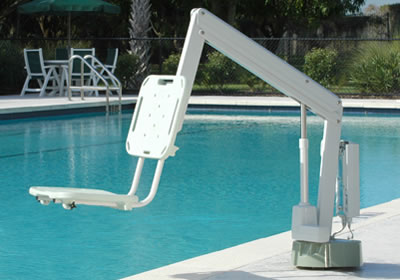 So pool operators have been given a 60-day extension to come up with an ADA-compliant plan for having public pool access for disabled individuals. The ADA pool access law was passed in 2010; the original deadline to comply with it was March 15, 2012. And somewhere in between, the new ADA pool lift regulation law has earned the moniker, “Poolmageddon”.
Even with the year+ lead time, did anyone really think that every pool affected by the ADA pool access law would a) figure out exactly what the law–the nitty gritty parts one needs to understand in order to comply—meant; and b) be able to source pool lifts, install the pool lifts, train staff, and do whatever else was needed to remain open (or avoid risking a DOJ wrist-slap or worse) by March 15?
One could argue that the public pools had plenty of time to be planning for this—but, if you’re at all familiar with public pool operation, it’s not like money is pouring in, so even a portable pool lift that doesn’t require electrical grounding or ripping up the pool deck can cost in the range of $6,000. Not pocket change for most pools. So it’s easy to see how compliance in providing disabled individuals with pool access may have been pushed to the back burner in many a pool budget meeting.
But once the public pool owners’ and operators’ backs were to the wall, and they had to figure out exactly what was required by the ADA pool accessibility law, well, who knew?
If it weren’t for the fact that ADA compliance is a serious issue—and no one wants to see the rights of a disabled individual curtailed or not honored, nor does anyone what the DOJ breathing down his neck—there would almost be a comical element to pool operators scrambling to figure out what the hell the ADA pool lift law means. There’s even an ADA Pool Lift Regulations group on LinkedIn—and the questions and comments sound in line with someone who’d been dropped into a corn maze at dusk without a flashlight and is screaming for help.
Much of the issue is the wording (ain’t it always so?) of the law. In order to comply, public pool operators must accommodate disabled individuals to the extent that it is “readily achievable” to do so. Uh, yeah. So if cash flow is not readily flowing, does that mean a pool lift is not readily achievable?
In reading a LinkedIn comment, it seems the Assistant AG for the Civil Rights Division at the DOJ responded to the “readily achievable” question posed in a letter from the American Hotel & Lodging Association (AH&LA). The response stated:
- “readily achievable [ is,] i.e., easily accomplished without significant difficulty or expense.”
- “…portable lifts can be used at existing pools if affixing the portable lift or installing a fixed lift is not readily achievable”, but must be fixed when it is readily achievable.
- The DOJ believes that the regulation as written provides the flexibility necessary for these entitles to evaluate whether and how to remove barriers to access and to take only actions that they deem are “readily achievable.”
Hmm. So you’re telling me I have to comply, but I have complete latitude to determine if—based on if I think it’s readily achievable—I will or will not comply—right?
You can see where this is heading, right?
Hello litigation!
There are other rather gray or vague areas to figure out as well—such as whether the need to comply with a pool lift is actually still an issue if you’re pool has a sloping entry. Good question. So it’s a veritable can of worms….
Let us know what you think—keeping in mind the issue is not whether or not disabled individuals should have pool access—they should. The issue is in how it’s regulated.
Open-Season Surveillance: GPS Under the Hood
September 13th, 2010. By Hunter West
 How far is too far?
The capacity for a police department to surreptitiously affix a GPS (Global Positioning Satellite) unit under a suspect’s car and track the hapless individual for weeks at a time without his knowledge (and without a warrant) is not only raising the hackles of human rights activists—it’s also fostering disagreements amongst judges.
Either way, the Fourth Amendment needs an overhaul in this day of high-tech, advanced technology.
I suppose there were complaints about this same thing in a bygone era, when telephones were all the rage (land phones, not cell phones) and police figured out that if they tapped into someone’s phone line, they could recover secrets and private conversations (read: evidence) they would otherwise not have access to.
But they needed a warrant for that. And a warrant for searching someone’s premises. Approaching the court and seeking permission to invade the privacy of a suspect for the purpose of an investigation—assuming the police could provide adequate grounds for the request—added a welcome buffer into the mix.
But should the police require a warrant to put a GPS tracking device under someone’s car?
The courts are divided on the differences between long-term, and short-term surveillance.
Traditionally, the Fourth Amendment is held by the courts as not covering the trailing of a Read the rest of this entry »

Find us on


Archive by Category
- Accidents (24)
- Airlines (9)
- Asbestos Mesothelioma (262)
- Automotive (25)
- Celebrity (14)
- Class Action (84)
- Complaints/Comments (15)
- Consumer Fraud (84)
- Contest (2)
- Court of Public Opinion (5)
- Crazy Sh*t Lawyers See (61)
- Criminal Law (4)
- Defective Products (111)
- DePuy ASR Hip Recall (2)
- Discrimination (22)
- Drugs/Medical (248)
- Elder Care Abuse (4)
- Emerging Issues (462)
- Employment (54)
- Environment (52)
- Financial (28)
- Food Illness (15)
- Human/Civil Rights (4)
- Insecurities (5)
- Insurance (16)
- Intellectual Property (16)
- Internet/E-commerce (19)
- lawsuits (161)
- Lawyers (20)
- Lawyers Giving Back (43)
- Lex Levity (10)
- Personal Injury (106)
- Pleading Ignorance (53)
- Real Estate (2)
- Recall (6)
- Scam (3)
- Securities (13)
- Settlement (81)
- Tort Reform (2)
- Totally Tortelicious (81)
- Veterans (11)
- Whistleblower (9)