Emerging Issues Archive
The Case of the Vibrator that Knew Too Much?
September 20th, 2016. By LucyC
 Smart dildos? Be careful what you wish for.
Don’t really know where to start with this one, except to say, you just can’t make this stuff up. A federal wiretap class action lawsuit has been filed against a company that makes “sensual lifestyle products”—including vibrators. The lawsuit is brought by a woman who alleges her vibrator is recording the date and time of each use, together with her selected settings and email address. (Now that’s multi-tasking).
So, first thoughts? There must be something wrong—the product is defective. Realty check—no—the product is working just fine. In fact, just as intended. Next thought—how is this legal and who wants this information? I mean, Really??
The skinny is that the We-Vibe vibrator is made to be operated through a smartphone app. According to the lawsuit, in order to operate the We-Vibe, “users download defendant’s ‘We-Connect’ application from the Apple App Store or the Google Play store and install it on their smartphones.” Easy enough, do it on the subway on the way to work.
The concept behind this product, from the user’s perspective, is to enable the user and her partner, through a “connect lover” feature, to operate the vibrator by remote control using their smartphones, even when they are physically separated. So—down the street, another city—another continent. Maybe even from 35,000 feet up, in the friendly skies. And then there’s the whole distracted driving thing. Hah! The touch screen allows the users to control the type, frequency and intensity of vibrations through 10 modes on a promised “secure connection.”
I’m having a hard time imagining a room full of nerds working on this one. But, thinking about it, maybe not. Wonder how much research went into developing the settings? And how was the research done—or is it all just random? Is there a process for complaints—and can you send the product back if it doesn’t live up to expectations? I digress, but then again—is that even possible anymore?
Meanwhile, back in the basement, the “defendant fails to notify or warn customers that We-Connect monitors and records, in real time, how they use the device. Nor does defendant disclose that it transmits the collected private usage information to its servers in Canada,” according to the lawsuit. Why Canada? Because We Vibe is in fact made by Ontario-based Standard Innovation Corp.
Thinking of Ashley Madison now…another banner Canadian company.
But the really dark part of all this is, according to John Banzhaf, a public interest law professor at George Washington University Law School, who published an essay on this, if a hacker—whether a former lover or a total stranger—intrudes on the We-Vibe information, he or she could conceivably be charged with sexual assault or even rape. “Since the smart dildos are connected to the internet, and can be controlled by someone even on another continent, hacking is an obvious possibility and potential danger,” Banzhaf says. As one writer put it, this brings a whole new meaning to phone sex.
The complaint, filed in Illinois, claims violations of various state and federal laws, alleging violation of the U.S. Wiretap Act, the Illinois Eavesdropping Statute, and the Illinois Consumer Fraud and Deceptive Business Practice Act. It also states these violations constitute intrusion upon seclusion in Illinois, as well as unjust enrichment on their profits.
The plaintiff has an initial hearing scheduled for November 8. Be interesting to see if it makes it to that far.
Gripping stuff!!
Hey Guys, Are you in a State of Propecia Sexual Dysfunction?
June 10th, 2016. By AbiK
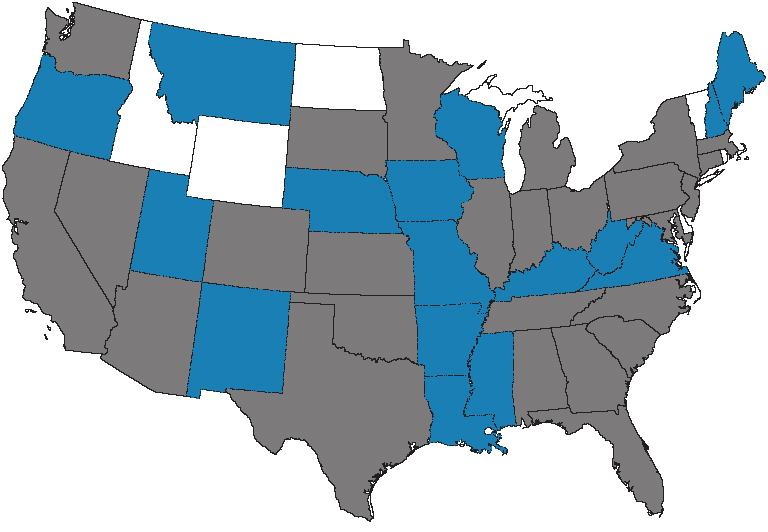
UPDATE: Since we first published this post (7/24/11), we reviewed the states in which we’ve received complaints regarding Propecia–some of which have had lawsuits filed. Forty-six US states have now been represented by Propecia complaints. The states shown in blue above are those that have seen complaints since the original post was published, below.
This whole Propecia sexual dysfunction thing got me wondering if there were any patterns (male pattern baldness aside) to where guys were experiencing the most negative Propecia sexual side effects, allegedly brought on by Propecia for hair loss treatment.
Being a data geek at heart, I took a look at where all these guys have been coming from—thinking that surely they’d hover around image-conscious L.A. or Miami—or in more major metro employment hotbeds where one might be concerned about age discrimination upon walking into an interview with a receding hairline—places like New York City or Boston or Chicago.
But it seems Propecia and its reported not-so-nice sexual side effects don’t discriminate—or at least not obviously so. Take a look above—the gray states are those from which LawyersandSettlements.com has received comments and complaints from guys sharing their Propecia sex problem stories. There’s no readily discernible pattern as to where guys who’ve taken Propecia and experienced sexual problems live. Propecia problems, it seems, have been happening allover. (And no, Hawaii and Alaska aren’t here, nor have I included Canada—but we’ve heard complaints from each).
To be clear, we’re not talking a low-key kind of sexual not-in-the-mood thing. These are guys who allege the mind is willing, wanting and very in the mood, but the body is not, shall we say, ramping up to support the mood. Alleged Propecia sexual side effects include a wide range of sexual dysfunction: erectile dysfunction, inability to ejaculate, low sperm count—leading to inability to conceive, and yes, even lack of sexual desire. Not the things a virile young (or older) man wants to be dealing with as he’s in the prime of his dating years or trying to start a family or just trying to remain intimate with his wife.
And, I don’t think I need to tell you that the situation doesn’t only affect the guys here—there’s that “other half” who’s involved. After a while, a Propecia victim may find himself absent-mindedly humming a Doors’ medley that started nicely enough with “Light my Fire” (as in, “C’mon baby…”) and ended with the more frustrating “Don’t you love her as she’s walking out the door”…as for some women, walking out will be exactly what they do.
My fear is that the above map is only the beginning as more men begin to come forward and share their stories. It takes guts to admit one’s short-comings and to reveal sexual inadequacy vs. dancing around it or remaining in denial about it takes a set of you know what—particularly when it’s as a result of trying to overcome another ego-deflator: hair loss. But if you’re in a state of sexual dysfunction and you think it’s a result of Propecia side effects, better to be in a state that’s complaining vs. a state of denial. Get some help.
Hired to Drive, Told to Assemble (IKEA!), Suing for $1.7M
January 8th, 2016. By LucyC
Ok—finally!! After all these years, confirmation!! Every time I had to put together a piece of Ikea furniture I would stall for days—weeks sometimes. After all, I’d survived for a year without that particular piece of furniture—what’s a few more days, right? In fact, the products could lay for months in their boxes, untouched, while I gathered the nerve, the tools and the beer necessary to put a table, desk or wardrobe piece together. Now there’s a guy in New York who’s suing his employer for forcing him to single-handedly put together a 225-pound piece of Ikea furniture by himself. Thank you! (doing a happy dance)—It’s not just me.
Fifty-two year old Carlos Figueroa, a chauffeur to Sweden’s UN Ambassador, alleges in his lawsuit that he endured Scandinavian-style torture when his boss forced him to single-handedly build a massive IKEA wardrobe. He claims that “handyman” was not part of his job description—likely nor was masochist. So, are you sitting down? He’s suing the Swedish Mission in Manhattan for $1.7 million (that’s a lot of wardrobes). He claims he was injured on the job and cites discrimination from his superiors.
The story goes that Figueroa was sent to Ikea in Elizabeth, NJ, to buy “one or two” “Pax” wardrobes (see Ikea video, above) with “Hasvik” sliding doors by his boss, the late Ambassador Marten Grunditz. What’s your first clue this furniture is going to be too heavy, and it turns out, too big for Figueroa to haul back to Manhattan on his own? And anyone who’s tried to get even a Trofast storage bin unit out of the Elizabeth, NJ Ikea store knows the concept of ‘grab ‘n go’ is royally put to the test. So…Grunditz told him to order the units. Yeah, thanks a lot.
When the furniture arrived at the Mission, complete with instructions that clearly show the furniture should be assembled by two people (why are they smiling?), Figueroa was told to assemble the 8-foot-by-7-foot piece by himself.
No additional manpower was provided, despite Grunditz being aware that Figueroa wasn’t a “workman or carpenter,” his suit states.
It took Figueroa three days apparently, to negotiate the instructions, parts (no doubt including endless packages of screws and the ubiquitous Alan key) but he did it. Except for hanging the sliding doors. He was in the process of hanging them when he fell off the five foot ladder and injured his back. He had to have back surgery to relieve pressure in his spine and fix pinched nerves. Wait—there’s more—he also suffered leg injuries. All this has forced Figueroa, who first started working as a driver and office clerk at the Mission in 2006, to take two medical leaves of absence, from September 2013 through February 2014 and from May 2014 onward.
“I’ll be in pain for the rest of my life. I’m disabled,” Figueroa told The New York Post, when they called him. “It’s been very emotional. I’m still in a lot of pain.” Yes, I should think so.
Despite his injuries, Figueroa continued working as a chauffeur after the accident, which, predictably, exacerbated his injuries, according to the lawsuit. Figueroa alleges he was told to lie to doctors about his continued duties “to avoid an uninsured Workers Compensation claim.” Boy, this just gets better and better. Not.
According to the lawsuit, “The important thing is for you to say that you don’t know how you got it and you don’t mention work,” a senior administrative officer under Grunditz texted Figueroa in December 2012. “So you want me to lie,” Figueroa texted back.
The worker responded: “Lying and withholding all info are two different things. You are an office clerk aren’t you? As it happens you don’t need to lie. As much as we don’t know the entire story behind your injury either,” the lawsuit states. So, how “gray” is grey, exactly?
Figueroa is also suing the Mission for discrimination: he claims his colleagues made disparaging comments about Latinos and questioned him about various missing items at the Mission. Seriously? And, there’s also an allegation of denied overtime despite working up to 18-hour driving shifts, with Figueroa claiming his boss said he was “paid too much.” FYI—Grunditz died January 2014.
According to Figueroa’s lawyer, Stanley Chinitz, who spoke with the Post, “Mr. Figueroa is not going to try his case in the press. He has accurately described the facts and this will be for a jury to resolve. Discussions occurred between the parties before the lawsuit was filed and the claims were unable to be resolved.”
You know, there ought to be a therapy group for survivors of Ikea furniture assembly—I’d join—though admittedly in most situations, the quest to assemble is purely self-inflicted.
Lawsuit: Do Snowboarders Deserve Equal Rights?
November 18th, 2015. By LucyC
 Right to access public land, discrimination, public safety or an overstated sense of entitlement? According to a group—a small group—of snowboarders—ok 4 snowboarders, the issue(s) lies behind door numbers 1 and 2. And they’ve filed a lawsuit to prove it. So what the heck am I talking about? To allow boarders on ski hills or not. Oh yeah baby—that old chestnut.
The powers that be in charge of Alta Ski Area in Utah have banned boarders from the ski hills. Why? They claim safety of the skiing public. So the 4 boarders are suing. They want access to them thar hills. They brought their lawsuit in 2014, and are alleging discrimination on the part of the resort.
In the interest of providing an unbiased opinion (possibly an oxymoron but let’s roll with it) I should disclose that I am a skier not a boarder. Having been clipped myself by a snowboarder—I can attest it hurts. Luckily, I was not injured but many others have been, some seriously. So, there is a heated debate about allowing boarders and skiers on the same slopes.
Back to the lawsuit…the lawyers representing the resort successfully defended their ban stating that resort officials made a business decision to entice skiers to the private resort east of Salt Lake City by promising a snowboarder-free experience, (kinda like a sand-flea free beach experience?) and it’s well within its rights to keep snowboards off the slopes.
The US Forest Service, which approves a permit for Alta, is also on the side of the resort, and backed up their boarder-free policy in court.
Attorneys for the four boarders have offered the counter argument that Alta doesn’t have the right to keep snowboarders off public land designated by Congress for skiing and other sports, pointing to 119 other ski resorts that operate on public land that allow snowboarding.
Of course, part of the problem is that Alta is world-class skiing and boarding territory. So everyone wants in. But at some point safety must come into the decision-making process. After all, we don’t allow cars on bike paths. Hell, pedestrians aren’t even allowed on bike paths, but that’s a whole cycling vigilante thing we best not get into here. I digress.
Back to the boarders. Their issue, their lawyers state, is with Alta’s claim that skiers find the slopes safer because they don’t have to worry about being hit by snowboarders who cannot always see skiers because their sideways stance leaves them with a blind spot. (Yes—true enough). And, the lawyers continue, Alta’s ban is irrational and based on stereotypes of snowboarders. Ok, don’t get me started.
Apparently, Deer Valley in Utah and Mad River Glen in Vermont also ban snowboarding.
In any event, the case got tossed last year by a federal judge in Utah (wonder if he is a skier…) so the four snowboarders who have now named themselves “Wasatch Equality,” have appealed to the 10th Circuit Court of Appeals, as you do.
This week, Fox News reported that the 10th US Circuit Court of Appeals heard arguments in the case. Wasatch Equality’s lawyer, Jonathan Schofield, argued the snowboarding ban violates the Equal Protection clause of the Fourteenth Amendment to the US Constitution by denying them access to the mountain. Seriously?
Yup. However, Schofield insisted he was not trying to get snowboarders declared a “protected class,” but press for equal access on government land. Surely they can still access the mountain? They just can’t go snowboarding on it. That’s different, I think.
“You don’t get to play favorites and decide who can come and who can’t,” he told FOX 13. Hmmm.
One of the three judges on the panel, Judge Gregory Phillips, asked “What if I want to take my toboggan down the slope? Would that be an equal protection violation?” Hello! Love it.
Alta insisted that it doesn’t discriminate against people, but has an equipment policy. “This case is about equipment. It’s not about people. It’s about a board,” said Alta Ski Area attorney Rick Thaler. “They’re the same person, the same beliefs, same race, gender, speech, clothing, cultural group.” Not quite sure what he’s on about there.
And so this goes on. The judges have taken the case under advisement with a decision is expected in a matter of months. Maybe at the end of ski season?
So—go get your skis on!
Not happy with State Law? Create your own Republic instead!
November 9th, 2015. By LucyC

Photo: Kerr County Sheriff/San Antonio Express News
When things get tough, have you ever thought of creating your own country? You know—when playing by your own rules really appeals? Like when money’s involved? But then you get to thinking about it and realize it could actually be quite a bit of work. What if there was an alternative? Maybe you could form a group of like-minded citizens, like the folks in Key West in Florida who consider themselves as citizens of the Conch Republic. They’ve even got their own flag, apparently. Or maybe there already is a group of like-minded citizens…
Such as in Texas. Bit of a history lesson here. Prior to Texas being annexed to United States, it was The Republic of Texas—its own country for a decade, between 1836 and 1846. Today, there are still some hold outs—including Susan Cammack, a single mother, a pleasant person, by all accounts, who considers herself a “Texian”—that is—a citizen of the Republic of Texas, and not the United States. (Wonder if she has a passport?) Never mind that she wasn’t actually alive to be a part of the actual Republic of Texas—she’s still living the dream.
So long as everyone stays out of trouble—no problem. But, when you start serving legal documents from your “sovereign nation” on a judge and lawyer, ordering them to appear before an “international common law court,” people may not take kindly to it, in fact they will probably decide to play by their rules and have you arrested—if they don’t contact the local psychiatric services folks first. And that is precisely what happened to Susan—the legal authorities were brought in.
The back story? Ms. Cammack was the subject of foreclosure proceedings. So she had a Houston-area chiropractor and the Republic’s chief justice, David Kroupa (oh yes—and why not?) issue a writ of mandamus and quo warrant to state District Judge Rex Emerson who was presiding over the case, and a subpoena to the attorney representing a title company, Bill Arnold. They were most seriously unimpressed.
As it turned out, the chiropractor/chief justice of the Republic of Texas was not acting in the best interests of his friend, because in the state of Texas, it is actually illegal to deliver “any document that simulates a summons, complaint, judgment or other court process with the intent to induce payment of a claim … or cause another to submit to the putative authority of the document.”
So, in February, Cammack was arrested during a raid on a Republic meeting in a VFW hall. Ok—wait—just pause to ponder that one: would Texians who are by default not Texans and, therefore, not part of the Union, be drafted for a foreign war? Do the Texians have their own military? But I digress…back to the raid… The raid, in fact, involved authorities representing the local sheriff’s office, FBI and other agencies and they seized computers, phones and other material from about 20 people participating in the meeting. Whoa Nelly!—the powers that be were in “take no prisoners” mode!
As for Kroupa/chief justice/chiropractor? He pled guilty to a misdemeanor and testified against Cammack at a legitimate trial in the State of Texas. Hey, loyalty to the Republic and fellow Texians apparently only goes so far. Cammack was convicted of three misdemeanor charges–for simulating legal process—ouch!—for which she must pay a $500 fine and serve two years probation. Well, that certainly worked out well. Not.
Cammack says she will appeal her conviction: “I believe my good name has been besmirched … my inalienable rights have been trampled on by the system.” Trampled on by the Republic’s system, I would say. She better hire a lawyer who practices state law, as in Texan law, I would say.
And you see, this is why it is so much better to fantasize about running your own country than actually trying to do it. Important to remember at tax time…

Find us on


Archive by Category
- Accidents (24)
- Airlines (9)
- Asbestos Mesothelioma (262)
- Automotive (25)
- Celebrity (14)
- Class Action (84)
- Complaints/Comments (15)
- Consumer Fraud (84)
- Contest (2)
- Court of Public Opinion (5)
- Crazy Sh*t Lawyers See (61)
- Criminal Law (4)
- Defective Products (111)
- DePuy ASR Hip Recall (2)
- Discrimination (22)
- Drugs/Medical (248)
- Elder Care Abuse (4)
- Emerging Issues (462)
- Employment (54)
- Environment (52)
- Financial (28)
- Food Illness (15)
- Human/Civil Rights (4)
- Insecurities (5)
- Insurance (16)
- Intellectual Property (16)
- Internet/E-commerce (19)
- lawsuits (161)
- Lawyers (20)
- Lawyers Giving Back (43)
- Lex Levity (10)
- Personal Injury (106)
- Pleading Ignorance (53)
- Real Estate (2)
- Recall (6)
- Scam (3)
- Securities (13)
- Settlement (81)
- Tort Reform (2)
- Totally Tortelicious (81)
- Veterans (11)
- Whistleblower (9)