Discrimination Archive
No Joke: King Arthur ‘Reincarnated’ Files Parking Fee Lawsuit
January 10th, 2017. By LucyC
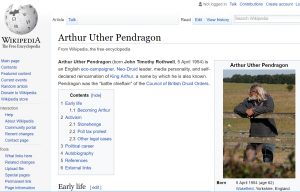
Pendragon’s Wiki page, 1/10/17
Pay to Pray? Not on your life! Love this. King Arthur Pendragon—the legendary King of England and Excalibur Knight—has come back to defend rights of people to pray without having to worry about their parking. It’s the little things, right?
It seems the English court has granted Pendragon the right to sue Britain’s national historical society over a £15 parking fee.
Just so we’re all clear, Pendragon was born in the century that only recently passed as John Timothy Rothwell but later changed his name to Excalibur. According to Wikipedia, in 1991, he was named Pendragon and Swordbearer to the Glastonbury Order of Druids. It turns out that the self-proclaimed reincarnation of King Arthur is a bit of a crusader (sorry, couldn’t resist) and no stranger to the English courts. Read the rest of this entry »
Lawsuit: Do Snowboarders Deserve Equal Rights?
November 18th, 2015. By LucyC
 Right to access public land, discrimination, public safety or an overstated sense of entitlement? According to a group—a small group—of snowboarders—ok 4 snowboarders, the issue(s) lies behind door numbers 1 and 2. And they’ve filed a lawsuit to prove it. So what the heck am I talking about? To allow boarders on ski hills or not. Oh yeah baby—that old chestnut.
The powers that be in charge of Alta Ski Area in Utah have banned boarders from the ski hills. Why? They claim safety of the skiing public. So the 4 boarders are suing. They want access to them thar hills. They brought their lawsuit in 2014, and are alleging discrimination on the part of the resort.
In the interest of providing an unbiased opinion (possibly an oxymoron but let’s roll with it) I should disclose that I am a skier not a boarder. Having been clipped myself by a snowboarder—I can attest it hurts. Luckily, I was not injured but many others have been, some seriously. So, there is a heated debate about allowing boarders and skiers on the same slopes.
Back to the lawsuit…the lawyers representing the resort successfully defended their ban stating that resort officials made a business decision to entice skiers to the private resort east of Salt Lake City by promising a snowboarder-free experience, (kinda like a sand-flea free beach experience?) and it’s well within its rights to keep snowboards off the slopes.
The US Forest Service, which approves a permit for Alta, is also on the side of the resort, and backed up their boarder-free policy in court.
Attorneys for the four boarders have offered the counter argument that Alta doesn’t have the right to keep snowboarders off public land designated by Congress for skiing and other sports, pointing to 119 other ski resorts that operate on public land that allow snowboarding.
Of course, part of the problem is that Alta is world-class skiing and boarding territory. So everyone wants in. But at some point safety must come into the decision-making process. After all, we don’t allow cars on bike paths. Hell, pedestrians aren’t even allowed on bike paths, but that’s a whole cycling vigilante thing we best not get into here. I digress.
Back to the boarders. Their issue, their lawyers state, is with Alta’s claim that skiers find the slopes safer because they don’t have to worry about being hit by snowboarders who cannot always see skiers because their sideways stance leaves them with a blind spot. (Yes—true enough). And, the lawyers continue, Alta’s ban is irrational and based on stereotypes of snowboarders. Ok, don’t get me started.
Apparently, Deer Valley in Utah and Mad River Glen in Vermont also ban snowboarding.
In any event, the case got tossed last year by a federal judge in Utah (wonder if he is a skier…) so the four snowboarders who have now named themselves “Wasatch Equality,” have appealed to the 10th Circuit Court of Appeals, as you do.
This week, Fox News reported that the 10th US Circuit Court of Appeals heard arguments in the case. Wasatch Equality’s lawyer, Jonathan Schofield, argued the snowboarding ban violates the Equal Protection clause of the Fourteenth Amendment to the US Constitution by denying them access to the mountain. Seriously?
Yup. However, Schofield insisted he was not trying to get snowboarders declared a “protected class,” but press for equal access on government land. Surely they can still access the mountain? They just can’t go snowboarding on it. That’s different, I think.
“You don’t get to play favorites and decide who can come and who can’t,” he told FOX 13. Hmmm.
One of the three judges on the panel, Judge Gregory Phillips, asked “What if I want to take my toboggan down the slope? Would that be an equal protection violation?” Hello! Love it.
Alta insisted that it doesn’t discriminate against people, but has an equipment policy. “This case is about equipment. It’s not about people. It’s about a board,” said Alta Ski Area attorney Rick Thaler. “They’re the same person, the same beliefs, same race, gender, speech, clothing, cultural group.” Not quite sure what he’s on about there.
And so this goes on. The judges have taken the case under advisement with a decision is expected in a matter of months. Maybe at the end of ski season?
So—go get your skis on!
White Guy Nets $3.25M Verdict in Racial Discrimination Case
August 16th, 2013. By AbiK
 Racial discrimination is something we’ve come to associate with minority groups—it’s rare that you see an item in the press about a non-minority being the victim of such discrimination, outside of say the occasional affirmative action case related to college admissions.
But, what if someone from the majority is actually part of the minority in a work situation? That’s what happened in a recent court case involving the city of Los Angeles.
In James Duffy v. City of Los Angeles, Duffy, a 63-year old Caucasian man who’d been working for the City’s Department of Recreation and Parks as a gardener for 19 years, alleged racial discrimination against his Hispanic foreman and coworkers. According to court documents, Duffy’s foreman, Abel Perez, allegedly began discriminating against Duffy upon becoming his foreman back in 2004.
Duffy claimed he was forced to retire after several discriminatory events took place—including some harassing incidents that happened after Duffy had suffered an on-the-job head injury, resulting in short-term memory problems. According to the filing, Duffy stated he’d complained to his supervisors several times but to no avail.
Some of the alleged discriminatory actions included Perez once stating “I hate white people.” Perez would also allegedly tell Duffy he hadn’t been given certain assignments when he had or that he failed to complete assignments he had never actually been given.
The complaint also stated the city of Los Angeles engaged in intentional racial discrimination by maintaining a “systematic and continuous policy and goal of firing and demoting Caucasian employees”—and that the city took no action after Duffy had made numerous complaints about the harassment he was enduring.
The case, James Duffy v. City of Los Angeles, Los Angeles Superior Court, Central , BC454369, went before a jury and a verdict was returned in favor of Duffy. The $3,255,000 verdict was unanimous on claims of disability and racial harassment, retaliation and discrimination by the City of Los Angeles and three of Duffy’s supervisors. The verdict comprised $380,000 in economic damages and $2,875,000 in non-economic damages.
The Kid’s Alright: #FreePatBrown if you Believe in Freedom of Speech
May 29th, 2013. By AbiK
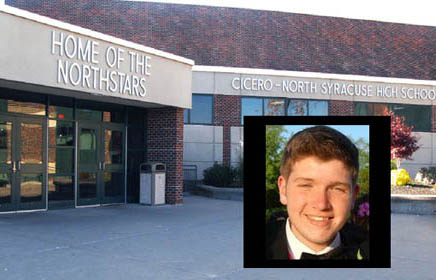 This kid’s onto something. Unfortunately, he’s also out of something: school. He was apparently suspended for exercising his First Amendment rights. Here’s the story…
Pat Brown is young. He’s engaged. No, not as in heading to the altar—he’s socially aware and he’s participating in the dialog about his local school board budget. That would be the Cicero-North Syracuse (CNS) High School 2013-2014 budget, which hasn’t yet passed—it was rejected by voters last week.
Pat Brown, student at CNS High, is a concerned student; and he should be—according to a report at CNN, the CNS school board had warned that if the budget isn’t passed, cuts would be necessary—to things like athletic programs, extra-curricular activities and even the elimination of some teacher positions. Things that create and support a robust learning environment for students.
Pat Brown is just a kid—he’s 18, but for all intents and purposes, he’s a high school kid. But he employed the one thing—most likely the only thing—that he could to make his voice, and the voice of his fellow students, heard: he created #shitCNSshouldcut. Humorous, in a shitmydadsays kind of way? Yes. A welcome mat for a wide range of both constructive and negative suggestions? Absolutely. But he achieved the most important thing—he got the conversation going and undoubtedly helped raise awareness among the budget’s main constituency, the student body of CNS High.
But the story doesn’t end there. Sure there were tweets using the hashtag. You can imagine the range of comments—but what really set this story in motion is that Brown, himself, tweeted that CNS High’s executive principal should be let go. And that was apparently a no-no. Result? A three-day suspension for Brown. According to his own Twitter stream, he’s out till this Thursday (5/30).
Now, what’s interesting here is that while some reports indicate that Brown was on his cell phone in class—which in many schools would lead to some form of disciplinary action, though perhaps not immediate suspension—that doesn’t appear to be the impetus for the suspension. According to the CNN article, Brown says he was “called into the office and told he would be suspended for three days for harassing the principal, using a mobile phone in class and disrupting the learning environment.”
There’s the key: “harassing the principal”.
Harassing? It was Brown’s personal opinion that the executive principal is not performing up to snuff. He tweeted it. Unless there’s a serious chunk of the story that isn’t being reported, that doesn’t sound like harassment—it sounds like free speech.
Earlier, I said this kid is onto something. Here’s evidence of that—he tweeted this on May 25th:
“People who are comparing this to me insulting my future employer need to realize one thing…I do not work for my principal.”
You got that right. It’s taxpayer dollars that are paying the school administration’s and teacher’s salaries. And it’s not the principal who determines how the U.S. Constitution is to be interpreted (shameless plug: that would be for trial lawyers and the USSC to handle.)
Given that, perhaps the best suggestion for a CNS school budget cut came from @Rant_rant_rant:
“#shitcnsshouldcut Cut U.S. History classes, since the North Syr. school district no longer acknowledges the Constitution.”
Of course, I’m being facetious. But the tweeter’s got a point.
We’ll have to see where this story nets out, but in the meantime, a new hashtag has emerged: #FreePatBrown.
Hey Airbus, Fat People in Aisle Seats is No Solution
April 18th, 2013. By AbiK
Did you hear the latest? Airbus announced recently that they’ll offer the option of installing wider aisle seats on their A320’s to accommodate heavier, aka fat, fliers. This, in response to all the hullabaloo lately over the notion of charging super-size passengers a premium for airline tickets (The Independent has coined a new moniker for this class: “McPassengers“.)
The plan, which Airbus states is in response to “trends in demographics”, is to offer the Airbus A320 with aisle seats that are two inches wider. Where’s the extra width coming from—as let’s face it, there is finite space to work with in the cabin? Apparently from the center and window seats!
That’ll go over like a fart in church, guaranteed.
Can’t help but recall the image of Steve Martin sitting next to John Candy in “Planes, Trains and Automobiles” (see clip above). Granted, Candy gives new meaning to ‘passenger from hell’—but still.
At any rate, let’s play this out. Assume an airplane with wider aisle seats—to be sold to wider passengers at a premium. A “normal” sized person purchases the center or window seat, sans premium. All I need to say to exemplify that this will not be an ideal scenario is one word: bathroom.
Forget about your seating comfort during 95% of the flight when you’re sitting there, still undoubtedly scrunched or your personal space infringed upon—and it will be, as adding two inches—go ahead right now and look at a ruler—will not accommodate a mass amount of additional girth. Forget all about that. Think about the 5% of in-flight time that center- and window-seat passengers will have to get up to either relieve themselves or relieve their aching backs, thereby making the aisle-seat passenger get up—or necessitating an ungraceful attempt to maneuver around him or her. This will not make for good “how was your flight?” customer satisfaction scores.
It’s just sheet common sense.
Of course, there are other angles to this. Is it discrimination to steal from the thin and give to the fat without discounting the thin’s ticket price? Initial reports on this don’t indicate that there would be such discounts. Only that the wider seats would be sold at a higher price.
Then, will there be weigh-ins? Or something that measures body dimensions in such a way as to ensure that only heavier people will have access to those wider aisle seats? Or, could thinner people purchase those seats at a premium to ensure they aren’t going to be squished in-flight? And, if so, what if all the aisle seats are taken up and a fat person wants that seat—does the thinner person get bumped? or moved to first-class for the inconvenience?
Wider aisle seats at the expense of thinner individuals’ seat width is not the market segmentation solution here. It disregards the classic “don’t make your issue my issue” maxim of harmonious human coexistence. And that’s never a good thing at a cruising altitude of 30,000 feet.

Find us on


Archive by Category
- Accidents (24)
- Airlines (9)
- Asbestos Mesothelioma (262)
- Automotive (25)
- Celebrity (14)
- Class Action (84)
- Complaints/Comments (15)
- Consumer Fraud (84)
- Contest (2)
- Court of Public Opinion (5)
- Crazy Sh*t Lawyers See (61)
- Criminal Law (4)
- Defective Products (111)
- DePuy ASR Hip Recall (2)
- Discrimination (22)
- Drugs/Medical (248)
- Elder Care Abuse (4)
- Emerging Issues (462)
- Employment (54)
- Environment (52)
- Financial (28)
- Food Illness (15)
- Human/Civil Rights (4)
- Insecurities (5)
- Insurance (16)
- Intellectual Property (16)
- Internet/E-commerce (19)
- lawsuits (161)
- Lawyers (20)
- Lawyers Giving Back (43)
- Lex Levity (10)
- Personal Injury (106)
- Pleading Ignorance (53)
- Real Estate (2)
- Recall (6)
- Scam (3)
- Securities (13)
- Settlement (81)
- Tort Reform (2)
- Totally Tortelicious (81)
- Veterans (11)
- Whistleblower (9)