Class Action Archive
Hunger Pang Lawsuit: Moose Munch Lacking a Bunch?
February 14th, 2017. By LucyC
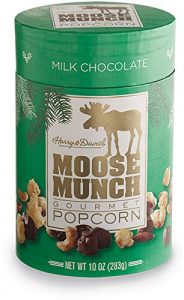 How much air is too much air? Who knows. BUT—we may be about to find out. No, not talking about this blog. Harry & David LLC gourmet foods got slapped with a consumer fraud class action lawsuit over slack fill in their popcorn canisters. There is some small irony here. What is popcorn if not flavored air? Surely that’s why it’s the diet food of choice for so many.
Back to the lawsuit. Filed by New Yorker Bria Brown, the lawsuit claims that an excessive amount of the 10 ounce package of (take a breath) Harry & David Moose Munch Milk Chocolate-flavored Gourmet Popcorn (got all that?) contained empty space—not including the popcorn.
Brown claims that she didn’t receive $7.99 worth of popcorn—expecting—reasonably, I would suggest—that the box would be almost full, if not completely full. Hey, if you’re on a diet, every ounce counts… Not saying Brown was on a diet. But if you’ve just shelled out eight bucks for some flavored popcorn—and you’re hungry—I doubt you’re going to be too pleased to find out you’ve got less food than you expected. Although I’m not sure popcorn is actually considered food. Read the rest of this entry »
5-Hour Energy Lawsuit: Defense Spins a Good One!
January 25th, 2017. By LucyC
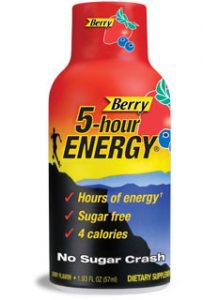 5-Hour Energy? Maybe, maybe not. The energy drink maker is the subject of multidistrict litigation (MDL) alleging consumer fraud, who would have thought? I know, I know. The gripe is that the energy boost ain’t all it’s cracked up to be, and that consumers swallowed the advertising in good faith (sorry, couldn’t resist).
The consolidated complaint was filed in January 2014. It claims that 5-Hour Energy states the drink gives long-lasting energy that “doesn’t jack you up with sugar, caffeine and herbal supplements.” The claim goes on, “defendants admit that the product provides no caloric energy at all.” So where does the energy come from then?
Read on…
Lawyers for the defendant and the plaintiffs recently sat down with the presiding judge to try and work this thing out. Lawyers for 5-Hour claim that it would be impossible for consumers to be deceived about the effects of the product they have purchased hundreds of times. The argument apparently followed the lines of 5-Hour Energy being an “experiential product”. Translation: you have an “experience” drinking 5-Hour Energy that may or may not be like the experience it claims you’re going to have. The consumer knows what that feeling is regardless and continues to buy the product, so they cannot reasonably claim they are being deceived or have made an uninformed choice. Have I got that right? Read the rest of this entry »
A Hairy Business! It’s L’Oreal’s turn to face a Haircare Lawsuit
December 7th, 2016. By LucyC
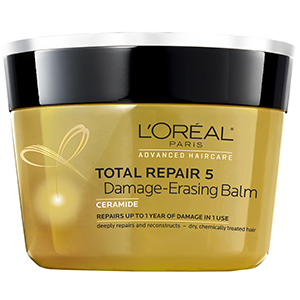
Image: L’OrealParisUSA.com
When is not being completely honest about a product’ benefits considered consumer fraud? Or more precisely, lawsuit worthy? L’Oréal might be about to find out. They got hit with a consumer fraud class action lawsuit recently, over allegations its Total Repair 5 Damage-Erasing Balm doesn’t do what it’s supposed to do. Ah expectations. They are so dangerous. Remember what the folks who bought Wen Cleansing Conditioner were expecting?
Given the name, Total Repair 5 Damage Erasing Balm, I’m not sure what, had I purchased the product, I should expect. The words “repair”, “erasing” and ‘balm” all appear in the name. So, does this product repair, remove or soothe your hair? Well, hopefully not remove (again, flashback: Wen…).
Surprisingly, according to Manhattan resident Vivian Lee, Total Repair 5 Damage Erasing Balm doesn’t do anything. Say whaa…? Would never have guessed. And, perhaps that’s a good thing, given that L’Oreal can’t seem to decide on exactly what it is supposed to do—if the name is any indication.
According to Lee, she bought a jar of this stuff at Walgreens and paid over $9 for the privilege or doing so. (Note, an 8.5 oz. jar of the stuff is available elsewhere online for $5-$7…) And apparently she says, “the only reason a consumer would purchase the Total Repair 5 Damage Erasing Balm is to obtain the advertised hair repair benefits.” Makes sense…
But—Lee claims that the product didn’t even come closer to approaching a “total repair” (whatever that means) of her hair. She claims L’Oréal “consistently conveyed the very specific message to consumers that the product will “repair up to one year of damage in one use,’” but “there are no ingredients in the Total Repair 5 Damage Erasing Balm that could actually repair a year’s worth of hair damage ‘instantly,’ particularly after one use.” Nothing works instantly after one use, except Twitter. Come on now!
I’d be interested to know what one year’s worth of hair damage look like? Baldness? Thinning, patchy hair? Bright orange hair with white roots? What? My idea of damage and yours could be very different. L’Oreal does however, try to cover its bases, by stating that its product would allegedly fix split ends, weakness, roughness, dullness and dehydration in hair.
But the science has it, in the end. According to Lee’s complaint, hair is made of keratin proteins, yes—we knew that. But, sadly, there are no keratin proteins in L’Oreals’ Total Repair 5 Damage Erasing Balm, so said product can’t do what it says. The product’s main conditioning ingredients, according to Lee, are behentrimonium chloride, amodimethicone and hydroxypropyl guar. And she says these ingredients are common in other products that do not claim to repair hair instantly.
Lee is looking to establish a nationwide class and a New York subclass. Her claims include violations of the New York general business law, negligent misrepresentation, breach of express warranty and unjust enrichment.
FYI—The case is Lee et al. v. L’Oréal USA Inc., case number 1:16-cv-09266, in the U.S. District Court for the Southern District of New York.
Gotta go—having my hair done… 😉
Wait, Krispy Kreme Doughnuts aren’t All Natural?
November 15th, 2016. By LucyC
 I have to be honest, the last thing I needed to read about this week was a lawsuit that attacks an institution—a food that has earned the right to be considered junk, in part because it makes no bones about it and in part because anything that tastes that good just has to be bad for you.
But heck, everything is fair game these days, it seems. And somebody has managed to drum up a 32-page, 32 pages—seriously?, Krispy Kreme lawsuit against the doughnuts over claims the doughnut chain is telling porky pies (lies) over the ingredients of its fruit-filled and maple-glazed donuts.
The allegations are that Krispy Kreme conducts “false and misleading business practices” because its “Chocolate Iced Raspberry Filled,” “Glazed Raspberry Filled,” “Maple Bar,” and “Glazed Blueberry Cake” doughnuts and doughnut holes do not actually contain real raspberries, maple, or blueberries. Oh dear. They might be able to call consumer fraud on this one, but not defective products, no siree—a box of Krispy Kremes could never be defective in my mind.
Plaintiff Jason Saidian, who for the record, lives in Los Angeles, is claiming the doughnuts are in fact made with nutritionally inferior ingredients.” WTF does that mean? Guess you have to read the whole 32 pages to find out.
Saidian’s story goes he bought the nutritionally inferior raspberry, maple, and blueberry doughnuts at issue from a Krispy Kreme location in Santa Monica. He claims he bought the doughnuts because he believed the company’s representations about the “premium ingredients” in its donuts.
For a little drama, the lawsuit apparently goes on to explain that the doughnuts are displayed in a tray behind a glass counter, along with a small placard in front of each tray that provides the name of the doughnut variety. But, I’m guessing, no laundry list of ingredients.
According to Saidian, the doughnuts appear as if they contain the “premium ingredients” but Krispy Kreme reportedly does not provide customers with access to information on what the actual ingredients are in the doughnuts. Ok seriously—who’s got time to read all that stuff—if you’re in there buying a doughnut I’m guessing you passed on the Kale smoothie for a reason.
Here’s all you need to know about the ingredients in doughnuts. They are, essentially, dough, fat, sugar, sugar, sugar, dough, fat, sugar and maybe some fruit preserves—with sugar in it—thrown in for good measure. Where’s the grey area? They can rot your teeth, expand your waistline, cause heart disease— if eaten liberally—just put that caveat in there—and for one brief moment, as all those questionably wonderful ingredients melt in your mouth in a kaleidoscopic orgasm of pure bliss—make you forget everything that’s wrong with the world. So you know what, just leave the doughnut alone, please.
But no. Not this guy. “Even when consuming the Products, Plaintiff and other consumers cannot easily decipher whether the filling or glazing they are consuming contain actual raspberries, blueberries, or maple ingredients, because the Defendant has formulated and manufactured the Products in a manner that masks the absence of such ingredients,” the class action states. So where’s the problem? Why worry about it?
It appears the rub is that Krispy Kreme is capable of making doughnuts with “real” ingredients in them—just for the sake of clarity—this is explained in the lawsuit as … the “Glazed Lemon Filled” doughnuts contain lemon juice, the “Cinnamon Apple Filled” doughnuts contain both apple and cinnamon and the “Glazed Strawberry” doughnuts contain strawberries.
Therefore, Saidain alleges, one can deduce that Krispy Kreme is not only capable of making the doughnuts at issue with real ingredients but, one would guess, should have, as people believe that’s what they’re getting. Therefore, Krispy Kreme should also have been aware that its products are falsely advertised and would be deceiving to an unsuspecting customer.
According to the lawsuit, Krispy Kreme allegedly (hopefully) uses sugar, corn syrup, gums and artificial food coloring to “mimic the texture, shape and color” of these “premium Ingredients” instead of naturally occurring products with proven health benefits.
Ok—hold on one fat saturated minute here—in no universe either known or as yet undiscovered are doughnuts considered to have any proven health benefits beyond the placebo effect. Somebody please give this guy some Kool-aid. Or a coffee…and a maple glazed doughnut.
Lexus Owner Sues for Shattered Sunroof
November 8th, 2016. By LucyC
 Own a Lexus? How’s the sunroof? Still there—intact? Maybe not for much longer…The luxury car maker got hit with a defective products lawsuit in October, over allegations its sunroofs spontaneously explode. That could certainly put a little excitement into your life. Several scenarios come to mind—none of them good.
According to Ginger Minoletti, who filed the Lexus sunroof lawsuit, she was traveling in her Lexus RX 350 on a California highway when the sunroof glass started making a loud noise. Minoletti says it sounded like the glass was cracking. Later on, she said she found pieces of glass inside the shade of the sunroof. Lucky that was all.
Apparently, there’s some defect that causes the glass to just shatter. You don’t even need to hit it with anything first—no prompting required. If you were a superstitious person, and even if you’re not, this could be quite disturbing.
According to the lawsuit, the sudden and obviously unexpected nature of these explosions leave drivers bewildered and trying to come up with an explanation for their no doubt shocked passengers, who may well be covered in glass shards.
The website carcomplaints.com, cites reports by Lexus owners, one made by an owner of a 2007 Lexus RX 350 in Austin, TX: “Travel back from New Orleans to Austin Texas on I-10 out in the middle of nowhere traveling 70mph and the sunroof on my Lexus RX-350 exploded into a shattering disaster. If shade had been opened it could have been detrimental bodily injury to myself or my passenger.”
And another by an owner of a 2013 Lexus GS 350 in Houston, TX: “2 month old car, was driving to work on a highway. Sunroof exploded and also got thousands of scratches from the shattered glass. I don’t understand why it’s not covered by manufacturer – anyway it’s not possible to prove anything to them.”
And another by an owner of a 2011 Lexus CT 200h in Washington, DC ….”I was driving back from Boston to DC. Just north of Newark Airport, while driving at highway speeds (60mph) there was a very loud explosive noise. Then I noticed a lot of wind noise in the car. I pulled off at the next rest stop and discovered that my sunroof was shattered. I had to make three trips to the dealership to find out what was going on. It took them 7 days to finally tell me that they would not cover the damage.”
Ah, there’s another problem. Who pays for the sunroof? Not Lexus, apparently. Minoletti claims that’s what happened to her. She got stuck paying for all the repairs to the sunroof because Lexus said the work wasn’t covered under warranty.
The kicker, according to the lawsuit, is that Lexus and its parent company Toyota have been aware of this issue since 2012, but, predictably, have done nothing to warn consumers.
Although the proposed class action lawsuit currently concerns California Lexus owners only, owners across the country have complained about having no warning the glass was getting ready to disintegrate.
The Lexus exploding sunroof lawsuit was filed in the Superior Court of the State of California, County of Los Angeles – Ginger Minoletti v. Toyota Motors Sales USA Inc.

Find us on


Archive by Category
- Accidents (24)
- Airlines (9)
- Asbestos Mesothelioma (262)
- Automotive (25)
- Celebrity (14)
- Class Action (84)
- Complaints/Comments (15)
- Consumer Fraud (84)
- Contest (2)
- Court of Public Opinion (5)
- Crazy Sh*t Lawyers See (61)
- Criminal Law (4)
- Defective Products (111)
- DePuy ASR Hip Recall (2)
- Discrimination (22)
- Drugs/Medical (248)
- Elder Care Abuse (4)
- Emerging Issues (462)
- Employment (54)
- Environment (52)
- Financial (28)
- Food Illness (15)
- Human/Civil Rights (4)
- Insecurities (5)
- Insurance (16)
- Intellectual Property (16)
- Internet/E-commerce (19)
- lawsuits (161)
- Lawyers (20)
- Lawyers Giving Back (43)
- Lex Levity (10)
- Personal Injury (106)
- Pleading Ignorance (53)
- Real Estate (2)
- Recall (6)
- Scam (3)
- Securities (13)
- Settlement (81)
- Tort Reform (2)
- Totally Tortelicious (81)
- Veterans (11)
- Whistleblower (9)