Airlines Archive
Hey Airbus, Fat People in Aisle Seats is No Solution
April 18th, 2013. By AbiK
Did you hear the latest? Airbus announced recently that they’ll offer the option of installing wider aisle seats on their A320’s to accommodate heavier, aka fat, fliers. This, in response to all the hullabaloo lately over the notion of charging super-size passengers a premium for airline tickets (The Independent has coined a new moniker for this class: “McPassengers“.)
The plan, which Airbus states is in response to “trends in demographics”, is to offer the Airbus A320 with aisle seats that are two inches wider. Where’s the extra width coming from—as let’s face it, there is finite space to work with in the cabin? Apparently from the center and window seats!
That’ll go over like a fart in church, guaranteed.
Can’t help but recall the image of Steve Martin sitting next to John Candy in “Planes, Trains and Automobiles” (see clip above). Granted, Candy gives new meaning to ‘passenger from hell’—but still.
At any rate, let’s play this out. Assume an airplane with wider aisle seats—to be sold to wider passengers at a premium. A “normal” sized person purchases the center or window seat, sans premium. All I need to say to exemplify that this will not be an ideal scenario is one word: bathroom.
Forget about your seating comfort during 95% of the flight when you’re sitting there, still undoubtedly scrunched or your personal space infringed upon—and it will be, as adding two inches—go ahead right now and look at a ruler—will not accommodate a mass amount of additional girth. Forget all about that. Think about the 5% of in-flight time that center- and window-seat passengers will have to get up to either relieve themselves or relieve their aching backs, thereby making the aisle-seat passenger get up—or necessitating an ungraceful attempt to maneuver around him or her. This will not make for good “how was your flight?” customer satisfaction scores.
It’s just sheet common sense.
Of course, there are other angles to this. Is it discrimination to steal from the thin and give to the fat without discounting the thin’s ticket price? Initial reports on this don’t indicate that there would be such discounts. Only that the wider seats would be sold at a higher price.
Then, will there be weigh-ins? Or something that measures body dimensions in such a way as to ensure that only heavier people will have access to those wider aisle seats? Or, could thinner people purchase those seats at a premium to ensure they aren’t going to be squished in-flight? And, if so, what if all the aisle seats are taken up and a fat person wants that seat—does the thinner person get bumped? or moved to first-class for the inconvenience?
Wider aisle seats at the expense of thinner individuals’ seat width is not the market segmentation solution here. It disregards the classic “don’t make your issue my issue” maxim of harmonious human coexistence. And that’s never a good thing at a cruising altitude of 30,000 feet.
Fat Flights: Is Pay-by-the-Pound Coming to Airline Tickets?
March 28th, 2013. By AbiK
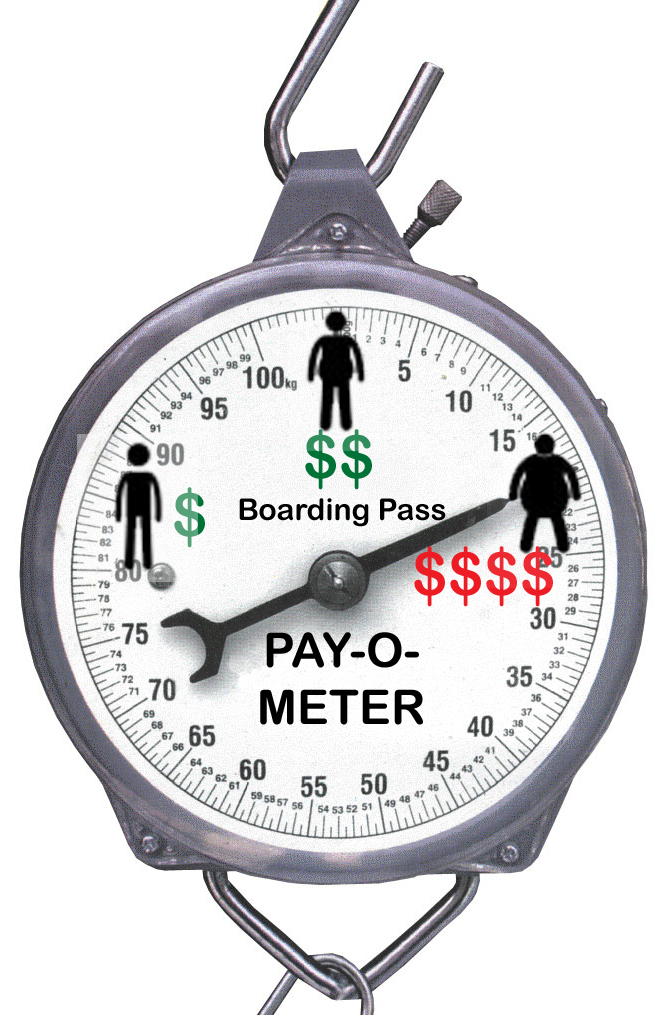 We’re not talking baggage here. We’re talking about YOU and those extra pounds of flab you’re lugging around.
There’s an analysis making the media rounds this week, done by economics professor Dr. Bharat P. Bhatta of Sogn og Fjordane University College in Norway. The analysis—an exploratory one, mind you—was published in the Journal of Revenue and Pricing Management and looked at the feasibility and logic of charging airline passengers according to how much they weigh.
It’s a loaded issue. After all, on the one hand, who of us hasn’t sat—scrunched—next to someone whose corpulence edged over the invisible seat boundary into our own personal space? And you’re left thinking, “This is what I paid $600+ for? Six hours of confined discomfort?” Yeah, you know what I’m talking about.
However, on the flip side of course, are those who are larger than a toothpick and, well, isn’t the concept of charging people according to weight a bit discriminatory?
So what’s this analysis all about? You have to take emotion out of the equation for a moment and look at this economically to understand the basis for the discussion. According to CBS New York, the economics are as such…
Bhatta cites an article in The Economist, saying “a reduction of 1 kg (2.2 pounds) weight of a plane will result in a fuel savings worth $3,000 a year and a reduction of CO2 emissions by the same token.”
His arguments stem from the notion that the more weight a plane is carrying, the “stronger an engine is needed and the more fuel it requires to carry” that weight. He also states that additional space is required to accommodate a heavier person.
The end result being a ticket cost that is “not fairly distributed among passengers,” according to Bhatta.
Viewed through that lens, it does cost more to haul more weight through the air—in terms of both cargo and passengers. And, viewed though that same lens (and my scrunched up image above), hasn’t current airline ticket pricing been a bit discriminatory to skinnier passengers then? It’s the classic “it’s your issue, don’t make it mine” argument for equitable or at least non-infringing treatment. And it’s food for thought.
This is not a new discussion. LawyersandSettlements.com has reported on the ‘what to charge fat people’ debate (and I’m not being ugly there—just calling it what it is) before—see our stories on ambulance fees for overweight people and also on overweight people looking for a manicure.
There is no easy or simple answer to this, and the suggestions Bhatta gives for how such a “pay-as-you-weigh” pricing model could be implemented are a bit ludicrous at best. One suggestion—the most obvious—is to charge fares according to actual weight by having a fixed rate per pound (for both “body and bags” as CBS points out).
Can you just envision the weigh-ins at the airport? Would there be curtained-off booths? Would anyone cheer if someone had lost a few pounds vs. their previous flight? (after all, your passenger history would be right there on screen, right?) Maybe Weight Watchers could rent meeting space in the main concourse areas of major airports. Just saying…
Public opinion was divided when John Montone from 1010 WINS in New York interviewed some passengers at Newark Liberty Airport yesterday. While the CBS News online report only shared the thoughts of heavier passengers, who of course were not in favor of such pay-by-the-pound tactics, the live interviews that aired on the radio also included opinion from the thinner set.
Regardless of how you weigh in on the situation (pun intended), somehow I don’t think any airlines will be lining up to implement this one, but you never know…
Southwest Learns Not to Screw a Lawyer out of a Drink (ever) & Gets a Hefty Bar Tab
December 28th, 2012. By AbiK
 Important tip: If you’re going to screw someone out of a drink, make sure he’s not a lawyer.
Southwest Airlines learned that the hard way last week when a judge approved the settlement for the recent class action lawsuit in which Southwest screwed its Business Select ticket purchasers out of some drinks.
Apparently, the way things were (where’s Barbra Streisand when you need her?) at Southwest, if a passenger purchased tickets through their premium Business Select program, the passenger would receive drink vouchers—valued at $5 each and with no expiration date—that they could then use in-flight.
Well, all fine and dandy until the fateful date of August 1, 2010. That’s when Southwest changed the rules of the game and decided that those drink vouchers could only be used on the day of travel that was printed on the ticket. Hmm…thinking of stockpiling vouchers for that red-eye flight? Not anymore you aren’t (and you may want to hold off on popping the Ambien…)
So someone raised an eyebrow at the switcheroo in policy and that someone was an attorney: Adam Levitt (of Wolf Haldenstein Adler Freeman & Herz in Chicago).
Levitt, clearly being an ‘e pluribus unum’ kind of guy, figured he wasn’t the only one affected by the disappearing drinks act and, therefore, from the many affected one class was formed and a Southwest Airlines drink voucher class action lawsuit was filed (November 16, 2011). Levitt, it goes without saying, was the initial plaintiff in the case.
According to Business Insider, the breach of contract lawsuit settlement affects those Southwest Airlines passengers who purchased tickets prior to August 1, 2012 through the Business Select program and received drink vouchers but did not redeem them–note, the settlement does not affect passengers who earned drink vouchers via the frequent flier program Rapid Rewards.
Further, BI reports that the drink voucher settlement entitles eligible fliers to new drink vouchers—even if they no longer have the original unused vouchers—for each voucher the passenger claims they had earned but not redeemed. The settlement drink vouchers will be good for one year.
Drink voucher lawsuit class members will reportedly be notified of the settlement and how to submit a claim over the next few weeks.
Chicago attorney Joseph Siprut, who represented the ‘took the drink right out of my hands’ victims, is quoted in BI as saying, “This settlement is a grand-slam result for the class, as consumers are recovering 100 cents on the dollar.” (not a shabby recovery, btw).
It’s estimated the Southwest drink voucher settlement could cost the airline in the area of $29 million, given that there are potentially 5.8 million fliers who are part of the class, having purchased and flown Southwest via the Business Select program between October 2007 and August 2010.
Jimmy Stewart Plane Crash Movie too Close to Reality 60 Years Later
April 28th, 2011. By Hunter West
The grounding of a Southwest Airlines 737 earlier this month due to a five-foot tear in the upper fuselage while the plane was in the air reminded me of a favorite old movie starring James Stewart.
‘No Highway in the Sky,’ a British disaster film made in 1951, follows the heroics and eccentricities of a professor and an expert in aviation who is commissioned to investigate the crash of a commercial airliner. Factoring in the age of the plane and the number of hours flown—not to mention the natural propensity of metal to weaken when under constant stress and subject to vibration—Stewart’s character theorizes that the plane crashed because the tail fell off due to metal fatigue.
He proceeds to rig a life-sized experiment in his lab, subjecting the tail section of an actual aircraft to vibrations and various in-flight sources of stress in an effort to replicate the actual crash, and to test his theory.
His colleagues think he is daft. But the movie—based on a novel—did contain some elements of truth.
That was borne out in the comments of a former North Carolina State University prof and expert in materials science, who says cracks in the bodies of commercial airliners are normal, and can be expected.
“It can happen with everyday things,” Charles Manning said in comments published April 4th on WRAL.com. “Take a paper clip and bend it back and forth. It’s going to break,” Manning said.
Of course, there are the engine vibrations—harkening back to that old Jimmy Stewart movie. But more precisely, Manning told WRAL that the act of pressurizing the cabin, allowing passengers and crew to breathe, stretches the metal skin in, and out with each pressurization. Over time, the metal wears down and cracks.
Fatigue cracks are small, he said—barely perceptible with a microscope when they first occur. It’s when they become more severe and can be seen by the naked eye, that they can potentially become a problem and are then subject to regular inspections.
Manning knows his stuff. For the past 30 years, he has headed Accident Reconstruction Analysis Inc., an engineering consulting firm that performs failure analysis and accident reconstruction. Before that, he was a materials science professor at North Carolina State, and he also headed NASA’s Langley Advanced Materials Research Program. He reminds travelers that planes are inspected regularly, and not to worry…
Not to worry?
Tell that to the frightened passengers on board the Southwest airliner when the five-foot gash blew open, suddenly de-pressurizing the plane. Yes, the aircraft landed safely and there was no loss of life or injury beyond sheer terror. However, the sudden de-pressurization of a cabin can serve as a vacuum, sucking anything out with the rapidly escaping air pressure—like papers, handbags…and if the breach happens to occur adjacent to a child who isn’t strapped in…
Well, you know the rest.
In the movie, Jimmy Stewart’s character forgot to provide for temperature in his calculations. The tail DID fall off in his lab, but a bit beyond when he said it would. Sadly, during the interim, he had caused damage to a similar plane on an attempt to prevent it from taking off (he was worried about the tail), and the daft professor was banished and dismissed as a crackpot.
Until, that is, the tail in his lab experienced fatal metal fatigue, cracked, separated and crashed to the floor.
Until, that is, the actual plane he tried to keep on the ground was repaired and sent up for a test flight without passengers. When it landed, the tail fell off…
It was just a movie, right?
Fact: Three years after the film’s release, there were two fatal crashes involving the world’s first passenger jet, the de Havilland Comet. Investigators determined that metal fatigue was the most likely cause of both accidents, although other sources point to a design flaw. No the tails didn’t fall off, but the fuselage gave way.
That was in 1954.
Then there was the infamous 1988 incident where cracks led to a massive breach in the roof and fuselage of an Aloha Airlines flight. Flight attendant C.B. Lansing was sucked out due to the rapid depressurization, and she fell to her death.
Manning assures that the Federal Aviation Administration (FAA) keeps the airlines on a tight maintenance schedule, including the testing by manufacturers of aircraft in an effort to gauge when, and where metal is likely to experience fatigue.
Did they miss something with the Southwest flight?
“I think planes are maintained as well as you can, and if the FAA sees that people are not doing it, they get after them,” Manning said.
That’s reassuring…
Hey, how about this idea. Figure out the point when metal starts to experience fatigue—and replace the bloody plane.
Oh, but that would be just too expensive, wouldn’t it? Planes cost millions of dollars. Fleets cost billions. We wouldn’t have an airline industry—it would not be economically viable.
Thus to have an airline industry, it appears that planes are required to stay in service as long as they are well maintained.
Complete with cracks.
Yes, I acknowledge those who maintain flying is still safer than driving—especially with so many people abusing their smart phones and GPS devices—or looking at their computerized dashboards–while driving.
That’s why I’m taking the train…
FAA, Where are You? Clearly Air Traffic Control is Oxymoron
March 24th, 2011. By Hunter West
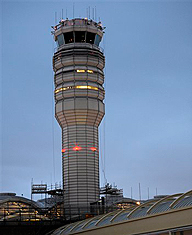 Now, wouldn’t that make a great reality TV series? Modeled after ‘Car 54 Where Are You,’ only in this scenario the two cops are replaced by two bungling air traffic controllers who don’t bother to answer when a pilot coming in for a landing, radios the approach tower at a major airport and gets no response.
Wait a minute—that would be incorrect. Because apparently there need be only one air traffic controller on duty…late at night…when things are quiet and it’s easy to nod off.
We don’t know if that was the case in the wee hours of yesterday morning when not one, but TWO incoming flights had to make do with input from regional towers and land at Ronald Reagan National Airport using unmanned airport protocol.
But this is bloody serious. Utter negligence. A lawsuit in the making, and a juicy one at that, had anything more serious happened.
According to a report yesterday in The New York Times and a compelling treatment on NBC‘s ‘Today’ this morning, an American Airlines Boeing 737 from Dallas approached the airport around midnight Wednesday but aborted its landing and circled the airport after pilots got no response from the tower. About 15 minutes later, a United Airlines Airbus 320 from Chicago also tried unsuccessfully to establish contact with the tower.
The controller in the tower at Reagan apparently re-appeared and all was well after that. The ‘Today’ show reported this morning that the controller who was on duty has an unblemished record (ps, the controller’s since been suspended, thereby blemishing that unblemished record).
Fine and dandy. But hey, FAA, why is it okay to have just one person in the tower? Would it not, Read the rest of this entry »

Find us on


Archive by Category
- Accidents (24)
- Airlines (9)
- Asbestos Mesothelioma (262)
- Automotive (25)
- Celebrity (14)
- Class Action (84)
- Complaints/Comments (15)
- Consumer Fraud (84)
- Contest (2)
- Court of Public Opinion (5)
- Crazy Sh*t Lawyers See (61)
- Criminal Law (4)
- Defective Products (111)
- DePuy ASR Hip Recall (2)
- Discrimination (22)
- Drugs/Medical (248)
- Elder Care Abuse (4)
- Emerging Issues (462)
- Employment (54)
- Environment (52)
- Financial (28)
- Food Illness (15)
- Human/Civil Rights (4)
- Insecurities (5)
- Insurance (16)
- Intellectual Property (16)
- Internet/E-commerce (19)
- lawsuits (161)
- Lawyers (20)
- Lawyers Giving Back (43)
- Lex Levity (10)
- Personal Injury (106)
- Pleading Ignorance (53)
- Real Estate (2)
- Recall (6)
- Scam (3)
- Securities (13)
- Settlement (81)
- Tort Reform (2)
- Totally Tortelicious (81)
- Veterans (11)
- Whistleblower (9)