Author Archive
Hey Guys, Are you in a State of Propecia Sexual Dysfunction?
June 10th, 2016. By AbiK

UPDATE: Since we first published this post (7/24/11), we reviewed the states in which we’ve received complaints regarding Propecia–some of which have had lawsuits filed. Forty-six US states have now been represented by Propecia complaints. The states shown in blue above are those that have seen complaints since the original post was published, below.
This whole Propecia sexual dysfunction thing got me wondering if there were any patterns (male pattern baldness aside) to where guys were experiencing the most negative Propecia sexual side effects, allegedly brought on by Propecia for hair loss treatment.
Being a data geek at heart, I took a look at where all these guys have been coming from—thinking that surely they’d hover around image-conscious L.A. or Miami—or in more major metro employment hotbeds where one might be concerned about age discrimination upon walking into an interview with a receding hairline—places like New York City or Boston or Chicago.
But it seems Propecia and its reported not-so-nice sexual side effects don’t discriminate—or at least not obviously so. Take a look above—the gray states are those from which LawyersandSettlements.com has received comments and complaints from guys sharing their Propecia sex problem stories. There’s no readily discernible pattern as to where guys who’ve taken Propecia and experienced sexual problems live. Propecia problems, it seems, have been happening allover. (And no, Hawaii and Alaska aren’t here, nor have I included Canada—but we’ve heard complaints from each).
To be clear, we’re not talking a low-key kind of sexual not-in-the-mood thing. These are guys who allege the mind is willing, wanting and very in the mood, but the body is not, shall we say, ramping up to support the mood. Alleged Propecia sexual side effects include a wide range of sexual dysfunction: erectile dysfunction, inability to ejaculate, low sperm count—leading to inability to conceive, and yes, even lack of sexual desire. Not the things a virile young (or older) man wants to be dealing with as he’s in the prime of his dating years or trying to start a family or just trying to remain intimate with his wife.
And, I don’t think I need to tell you that the situation doesn’t only affect the guys here—there’s that “other half” who’s involved. After a while, a Propecia victim may find himself absent-mindedly humming a Doors’ medley that started nicely enough with “Light my Fire” (as in, “C’mon baby…”) and ended with the more frustrating “Don’t you love her as she’s walking out the door”…as for some women, walking out will be exactly what they do.
My fear is that the above map is only the beginning as more men begin to come forward and share their stories. It takes guts to admit one’s short-comings and to reveal sexual inadequacy vs. dancing around it or remaining in denial about it takes a set of you know what—particularly when it’s as a result of trying to overcome another ego-deflator: hair loss. But if you’re in a state of sexual dysfunction and you think it’s a result of Propecia side effects, better to be in a state that’s complaining vs. a state of denial. Get some help.
Flashback Friday! Volkswagen Ads post-Volkswagen Lawsuits?
September 25th, 2015. By AbiK
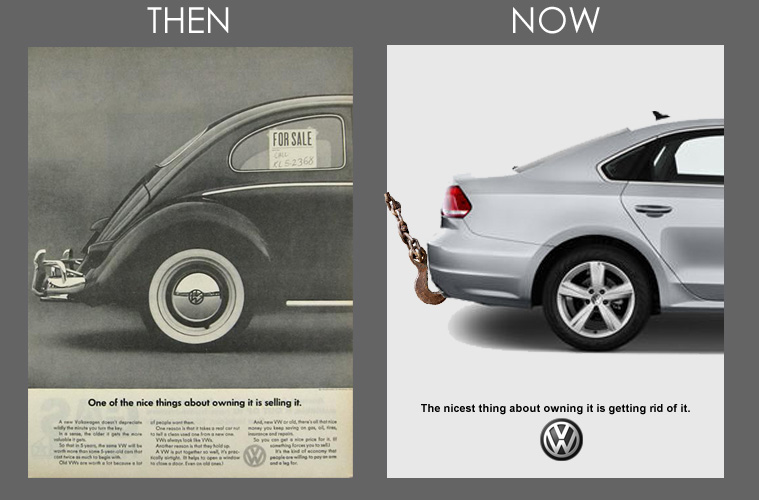
Yes, it’s time for a flashback Friday! Remember all those great Volkswagen ads of years gone by? Simple. Witty. Dare I say…trustworthy. Best of all, they poked humor at themselves. They totally got how folks were like “wtf??” when they saw a car that resembled something you’d step on in a heartbeat. And they ran with it. Yesiree…totally ran—straight to the bank. And flower children everywhere made the VW Bug the automotive emblem of their age. Complete love-fest.
But that was then. Fast-forward to September 18, 2015 when news broke about something called a “defeat device“. It sounded like something you’d grab in Minecraft to kill the Ender Dragon—but alas, it turned out to be much more sinister. As we all now know, it’s what VW installed in its diesel autos to suppress emissions so that the cars would pass emissions testing on a dynamometer—aka a stationary “rolling road” used to test cars (and no, we didn’t know what that was either until a week ago). Those emissions, however, when on an actual road, were spewing upwards of 40x more toxic fumes than permitted. Uh-oh! Where’s the love now folks? To die-hard VW fans, it’s a jilt they’ll never get over.
And now there’s a stack of Volkswagen lawsuits piling up.
But it’s worth looking back…at some of those VW ads of yore, and imagining those same ads circa 2015. Yes, the ads on the right are totally fake–just to be clear. But it’s easy to see how they could well be art imitating life right now… so here goes…


What’s in a Paint Name? Discrimination, Wrongful Termination, Retaliation…and more!
August 6th, 2014. By AbiK
 It’s not often that jurisprudence and home decor intersect. After all, let’s face it, one look at most attorney offices will tell you to look elsewhere for interior design inspiration. But this case—brought to us all compliments of a Mr. Clinton Tucker—is sure to rock the very foundation of the home improvement industry (not).
But I’m ahead of myself so let’s back things up a bit…
Clinton Tucker is a former Benjamin Moore employee who has filed a complaint in Essex County Court (NJ) alleging that the paint company fired him after he repeatedly complained about the “despicable and racially insulting paint colors called ‘Clinton Brown’ and ‘Tucker Chocolate.'” Tucker Chocolate, for those who don’t have a bedside copy of “Paint and Coating News“, is a paint color in the Benjamin Moore historical Williamsburg collection. In the filing, Clinton Tucker refers to himself as an African-American homosexual male—btw, fwiw—and he’s seeking damages for discrimination, retaliation and a hostile work environment.
Without going too deeply into this one, it sounds like a classic “you say ‘to-MAY-to’, I say ‘to-MAH-to'” type of case—you know, where it’s a matter of individual perception. After all, Clinton Brown sounds more to me like the shade of something Hillary (as in Clinton, as in the more caucasion-looking woman who may be running for President) would’ve asked Ralph Lauren to whip up in silk faille for some fete or soiree in the State Dining Room.
But no, Clinton Tucker, being African-American, apparently sees this quite differently—almost as if the Benjamin Moore design team named the Clinton Brown shade with only Mr. Tucker himself in mind! And of course, that same team looked no further than Mr. Tucker for the inspiration in naming their other brown color, “Tucker Chocolate”—coincidence? Hell no—and it HAD to be a racial slur…Never mind that the Williamsburg collection also has a T ucker Orange and Tucker Gray…where’s a gray-haired octogenarian filing a paint name discrimination suit when you need him/her?? Where the heck is the AARP on THIS one, huh??
Oh wait a minute—was that Tucker thing some sort of theme? Why yes it was—for a certain St. George Tucker. THIS Tucker (1752-1827) wound up in Virginia (funny, that’s where Williamsburg is!) by way of Bermuda to become a lawyer (who knew?). Here’s another funny thing—according to just about every online source that was checked for this post, St. George Tucker ‘urged for the abolishment of slavery’. Yes, he authored a pamphlet, “A Dissertation on Slavery: With A Proposal for the Gradual Abolition of It in the State of Virginia“.
So here’s the plot line for this lawsuit so far: Benjamin Moore develops a wide range of paint colors under the umbrella “Williamsburg”. In it, there are at least three colors named after, or in honor of, St. George Tucker—a seemingly respectable Virginian. While St. George Tucker—a would-be abolitionist—is rolling in his grave, a modern-day Clinton Tucker (no known relation to St. George) is suing Benjamin Moore claiming that the paint named for a white pro-abolition dude was actually some inside joke (ha-ha) meant as a racial slur. Are you still with me?
Well, perhaps the real story here is this excerpt from the filing that was re-printed at Courthouse News:
“Tucker claims that “despite his value, accomplishments and productivity for the company, the plaintiff was repeatedly denied opportunities for promotion and growth by BM due to his race” and that “despite spending countless hours in the office, the plaintiff was only getting paid for a 40-hour week…Tucker claims that Benjamin Moore eventually wrongfully terminated him in March 2014, but “retained Tucker’s two white, blonde-haired and blue-eyed subordinates.”
According to Tucker’s LinkedIn profile, he started at BM in June 2011—so he was there for 2 years, 9 months. And, according to a recommendation he received (see below), he actually had been promoted. The recommendation also makes you wonder if those “countless hours” were required, or just Tucker’s regular M.O…
“Clinton is the guy you want on your team when you need results. NO is just not an option. He will dig deep for data and map out a solution or track down an answer while jumping hurdles to do it. As part of the Digital Marketing team he brought a deep analysis of our data that we hadn’t seen before that drove results across all of our digital properties. His expertise in eCommerce helped set the stage for future growth and Clinton demonstrated leadership qualities well deserving of the promotion he received.” – Lisa Sharp, Digital Manager at SRSoft, who previously indirectly managed Clinton at BM
Regardless, if this has any legs, I’m thinking of letting my friend—the one who consistently robs the cradle, so to speak—know that she may have to find a lawyer and file a discrimination suit…Benjamin Moore also has a paint named “Cougar Brown”.
Who’s gotten that Chrysler Dodge Ram Recall Notice?
April 15th, 2014. By AbiK
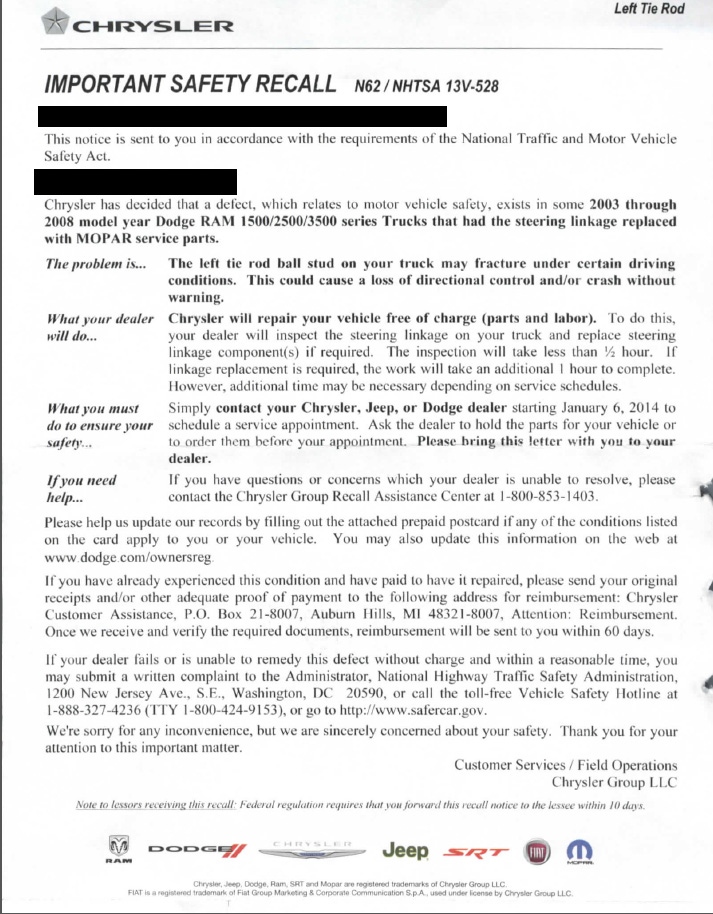
Did you ever receive one of these Chrysler Dodge Ram recalls for defective steering-system tie rods that may have been misaligned during assembly or steering-system service? Did you bring your truck in to have the part replaced? What’s your experience?
Totally Tortelicious: Is this Man Adam Sandler’s ‘Anger Management’ Successor?
April 15th, 2014. By AbiK
Where the hell is Jack Nicholson when you need him? The plaintiff in this case may benefit from some counseling—not the legal type—as he’s apparently got that—but the type that Nicholson doled out in the movie, “Anger Management” (see his Goosfraba therapy in action above.)
 Seems Geary Trigleth, plaintiff in a contract law dispute, was quite the colorful character in his recent deposition. And it started when he walked in wearing a t-shirt that screamed, “f*ck you YOU f*cking f*ck”—that’s our man, shown below. Yes, many a plaintiff—and defendant—has thought of showing up at his deposition or in court and giving a few people the F-bomb—but few actually dare to do it. Trigleth is the man, though, and he did.
Things got more interesting from there on as the deposition proceeded at Scheef & Stone law firm in Frisco, TX.
In eloquent terms nonpareil, Trigleth went on to provide passionate commentary regarding defendant Robert Couch.
According to court documents, in referring to Couch, Trigleth stated he was “going to tie that thick necked mother f*cker to a pole and f*ck him up the *ss until he squeals like a pig.”
One can only question whether Trigleth has experience with such. Regardless, speaking of personal relationships, the questioning did at one point veer into Trigleth’s own pursuit of pleasure—or sorry, his possible pursuit of a significant other who just happens to come via mail order (we’re guessing Match.com and Zoosk were off-limits for Trigleth given his online social reach is nil—literally—he has a profile on LinkedIn, but zero connections and his FB friends number 27—so maybe he off-shored love, as one does in these situations).
According to court docs, Attorney J. Mitchell Little started to ask Trigleth a number of relevant questions concerning his status as an accredited investor. Here’s how that went:
Q: Mr. Trigleth, what was the·purpose of the wire transfer that was paid? (Note: Mr. Trigleth also refused to answer and became very agitated at a line of questioning about a prior dispute with Texas Capital Bank where he was alleged to have transferred money for the purpose of acquiring a mail order bride.)
A: Are you gay?

Q: Are you going to answer my question?
A: Are you going to answer my question?
Q: I am here to ask questions.
A: I am here to ask you a question. Are you gay?
Geez. I don’t know—after a while one begins to wonder if a yes or no question starts to sound like a proposition there—or at the very least a fixation of sorts—hey, Little’s an attractive guy and he does have over 500 connections on LinkedIn. But as a little sidenote lest you question the line of questioning in the deposition…here’s a testimonial from Trigleth found over at 1st International Marriage Network (btw, IMBRA stands for International Marriage Broker Regulation Act):
From: Geary Trigleth
Sent: Friday, March 05, 2010 10:32 AM
To: Vasiliy Savkin
Subject: Re: IMBRA report prepared at NatashaClub site
Vasiliy,
Thank you so much for your prompt response and assistance. I enjoy your services and site and compliment the efficiency and strategy of the functionality of the site and services supported! I truly feel your attempt to support the members and strategically protect all involved to meet your business needs and empower the site members to employ there powers of there needs is very efficient and effective! I truly appreciate the services rendered and hope to maintain a continual working relationship in the future. My appreciation!
gt
Yessiree, sounds like someone’s been trying to off-shore some lovin’…
Who knows where it all nets out, but suffice to say it’s one of those court appearances we’d love to be an extra Montblanc ink cartridge lying on counsel’s table for…

Find us on


Archive by Category
- Accidents (24)
- Airlines (9)
- Asbestos Mesothelioma (262)
- Automotive (25)
- Celebrity (14)
- Class Action (84)
- Complaints/Comments (15)
- Consumer Fraud (84)
- Contest (2)
- Court of Public Opinion (5)
- Crazy Sh*t Lawyers See (61)
- Criminal Law (4)
- Defective Products (111)
- DePuy ASR Hip Recall (2)
- Discrimination (22)
- Drugs/Medical (248)
- Elder Care Abuse (4)
- Emerging Issues (462)
- Employment (54)
- Environment (52)
- Financial (28)
- Food Illness (15)
- Human/Civil Rights (4)
- Insecurities (5)
- Insurance (16)
- Intellectual Property (16)
- Internet/E-commerce (19)
- lawsuits (161)
- Lawyers (20)
- Lawyers Giving Back (43)
- Lex Levity (10)
- Personal Injury (106)
- Pleading Ignorance (53)
- Real Estate (2)
- Recall (6)
- Scam (3)
- Securities (13)
- Settlement (81)
- Tort Reform (2)
- Totally Tortelicious (81)
- Veterans (11)
- Whistleblower (9)